
Another Country Diary #67
With fog and a magpie

4/8
I set out for an early morning walk in fog. I love the way weather can transform a landscape, make strange a familiar scene. Snow, fog, and even rain can have this effect. This morning it is a radiation fog. It forms when the ground cools overnight below a layer of warm moist air. Put a mug of hot water in a fridge and you’ll see a similar effect. The warm moist air cools, condenses, and forms a ground hugging fog. The air is clammy. It must be about twenty degrees Celsius already. Still, I know that this will be the coolest part of day, and that I need to make the most of it.
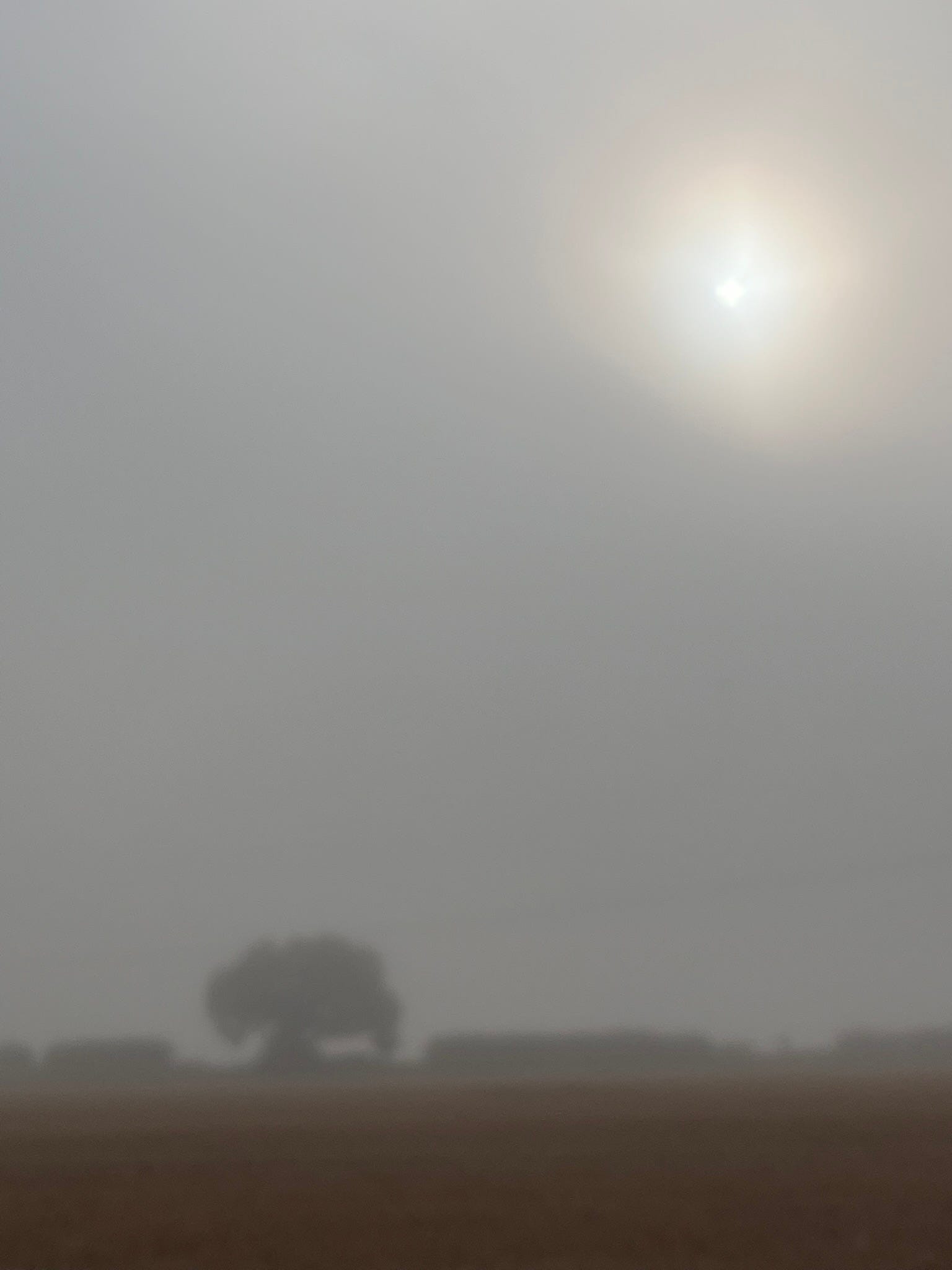
I prepare to be disappointed as I approach the fields that last week were the site of so many encounters with hares. I saw nothing on yesterday’s walk. I come to a break in the hedge and look into the field. The bales of straw have been collected, and the expanse of stubble extends until it fades into the mist. There is a rustling noise coming from the field margin next to me. A hare? I peer into the long grasses, and see, to my surprise, a male mallard. There is a drainage ditch which carries the beginnings of a stream next to this field, so perhaps it’s not so surprising. I carry on up the lane. There is a hare further up it, perhaps fifty metres away. It darts into a field entrance, but had come from the field opposite, crossing the road. I reach a gap in the hedge next to a large field oak and scan the field from where it had come. There are two dark shapes in the crops. I walk a little further on, to the next gap. The dark shapes have sprouted ears—hares crouching. I linger for a moment, watching. They are clearly alert to my presence, even though I’m a long run from where they are trying to hide in the middle of the stubble. Then I press on with my walk, off the lane and up the track towards the top fields. As I pass the old farmhouse, I see two roe deer begin to run from where they have been grazing in a field planted for wildlife seed. They round the hollow, putting the scrubby trees that edge the old excavation between me and them. A group of rabbits scatter, running for their burrows beneath the brambles. I stop by them to pick blackberries, storing them in the side pocket of my cargo shorts. The first fruits are ripening, though they are generally smaller than last year’s pickings. I expected the fog to be clearing by now, and the light is slowly beginning to strengthen, but even so, the oaks in the opposite hedgerow seem blurred, and the sun above them, a pale watery eye in white sky.
I spot another roe deer on the way back. It is on its own in the middle of a field. It looks like a juvenile, long-eared and leggy. It scampers across the stubble, directly towards me, before realised its error and freezing. I expect it to run, but to remains rooted. It would be an easy quarry for a Mesolithic hunter-gatherer. I walk on, down the track, and then look back up the vast field when I reach the end of the hedge. It is standing on the brow of the hill, silhouetted by the rising light, perhaps a few hundred metres from me, but wary still, alert in its posture.
I’m almost back in the village when I encounter one more hare. It is on the verge of a little used lane. It looks like a youngster, definitely smaller than the others I’ve seen. I’m already quite close to it when it sees me. I expect it to run straight off into the hedge, but instead it moves steadily up the lane towards me, crossing the road diagonally in my direction as if to greet me like a puppy. I’m astonished by its lack of fear. The moment is short lived. Like the roe deer, it realises the danger, and turns back the way it came, to the same spot on the verge, before kicking off through a hedge portal into the field beyond.
Despite the best efforts of the drought, the vegetable beds are starting to produce a decent crop of ripening tomatoes and swelling courgettes. The runner beans are struggling a little. I can’t see to water them enough. The other squashes are behind where they should be, but with luck we might get some butternut squashes.
5/8
I leave for my morning walk a little later. The heat of the night seemed to slow me in the morning. I was up at the usual time, but after feeding and mucking out the hens, and feeding the cats, I found myself scrolling, and (insanity when on leave) checking my work email. It is a little cooler, the sky crowded with grey and white cumulus. Still no sign of rain. The verges are still scattered with gold, straw from the bales that have been collected over the last couple of weeks. Now they are all collected and stacked. Harvest is over and August only just begun. On Sunday it was Lammas, or loaf-mass, a holy day to celebrate the first fruits of the harvest, when the first loaf from the first wheat of the harvest would be baked and offered. That harvest should be over before Lammas weekend is a sign of how out of show dangerously strained our food supply is becoming under the climate emergency.
I bump into a couple of neighbours walking their dogs in the lanes. The hares are nowhere to be seen, no doubt scared off by the excitable cocker spaniels. I’ve often wanted to own a dog, but I suspect I would see far less wildlife when walking. I don’t see any wildlife of note until I get to the top fields, though perhaps that’s because I’m walking swaddled in my own thoughts. The hares are at the far end of the large field. They spot me from a distance, and sit alert, before dashing for the shelter of the field margins. A pair of swallows sweep past me. They wheel around and dive again, fast alongside the hedgerows, close enough to touch.
On the way back along the lanes, I fill the side pocket of my shorts with blackberries. Only the largest. They seem dusty, like the tarmac. The soil here is a strange flinty mix. Clay-like when wet, but liable to turn gritty and powdery in the summer. We should be doing a rain dance, I find myself thinking. At least, some sort of rain-making ceremony. How long will it be before we are desperate enough to call on magic or the gods to intervene in our man-made disaster?
Some of my writing begins to take shape. It is a slow burn project that has smouldered since 2021. Parts have been published, but it is mostly in pieces, fragments, notes, and incomplete chapters. I spend the afternoon gathering up the pieces and assembling them into a document. When I am finished, I’m surprised to find it is already the length of a short book. Somehow it is easier to see it, as a whole, to know how the pieces might be shuffled, reassembled, and built upon.
6/8
I save my walk for after lunch. Today will be busier, so I limit myself to a shorter circuit that takes in “barking woods” and part of the lanes. The air is cooler this morning, a fresh wind blowing in from the west. The sky is clear and the sun intense. I thought it was raining during the night, but I think it was probably just the sound of the dishwasher on its cycle. The grass on the footpaths is still bleached out. The soil is dusty.
This walk was a favourite in the Covid lockdown of 2021, enough time for my then primary school aged daughter to walk during her PE lesson. The walk takes in a long stretch of road that I usually avoid. It was nicknamed ‘owl lane’ on account of us sighting a tawny owl roosting in a hedge oak during a rain shower. The road is used as a rat run between two B-roads, and cars speed along it in the rush hour. I keep close to the verges and watch the cars carefully. Some are driving too close to the car ahead of them, and so don’t have a clear view of me walking.
I see no wildlife of note until I reach the lanes. A scuffle alerts me to a small movement at the base of the hedge. A tiny movement that then still. I can see a small brown body. A bank vole. It slips out of sight. Another scuffling turns out to be a dunnock, equally small and brown. Further on, in the corner of a field that is being rested, and that has been planted regeneratively with a wildlife mix, swallows wheel and soar, zoom and boom, tearing past at head height in their pursuit of the tiniest of insects.
A magpie keeps coming to the kitchen door. It seems curious about our kitchen, peering in through the glass, and tapping it on occasion. I thought at first that it was responding to its reflection, but that doesn’t seem to be it. I think it wants to come in. Perhaps it’s intrigued by our lemon tree. It seems entirely unbothered by the cats.
7/8
There are dragonflies hawking where the swifts were yesterday, jinking and darting through the air. Southern hawkers, I’m guessing. They will be after the same prey as the swifts, tiny insects on the wing. I’m out a little later but the air is still fresh from a cooler night. The skies are blue and cavernous. No cloud.
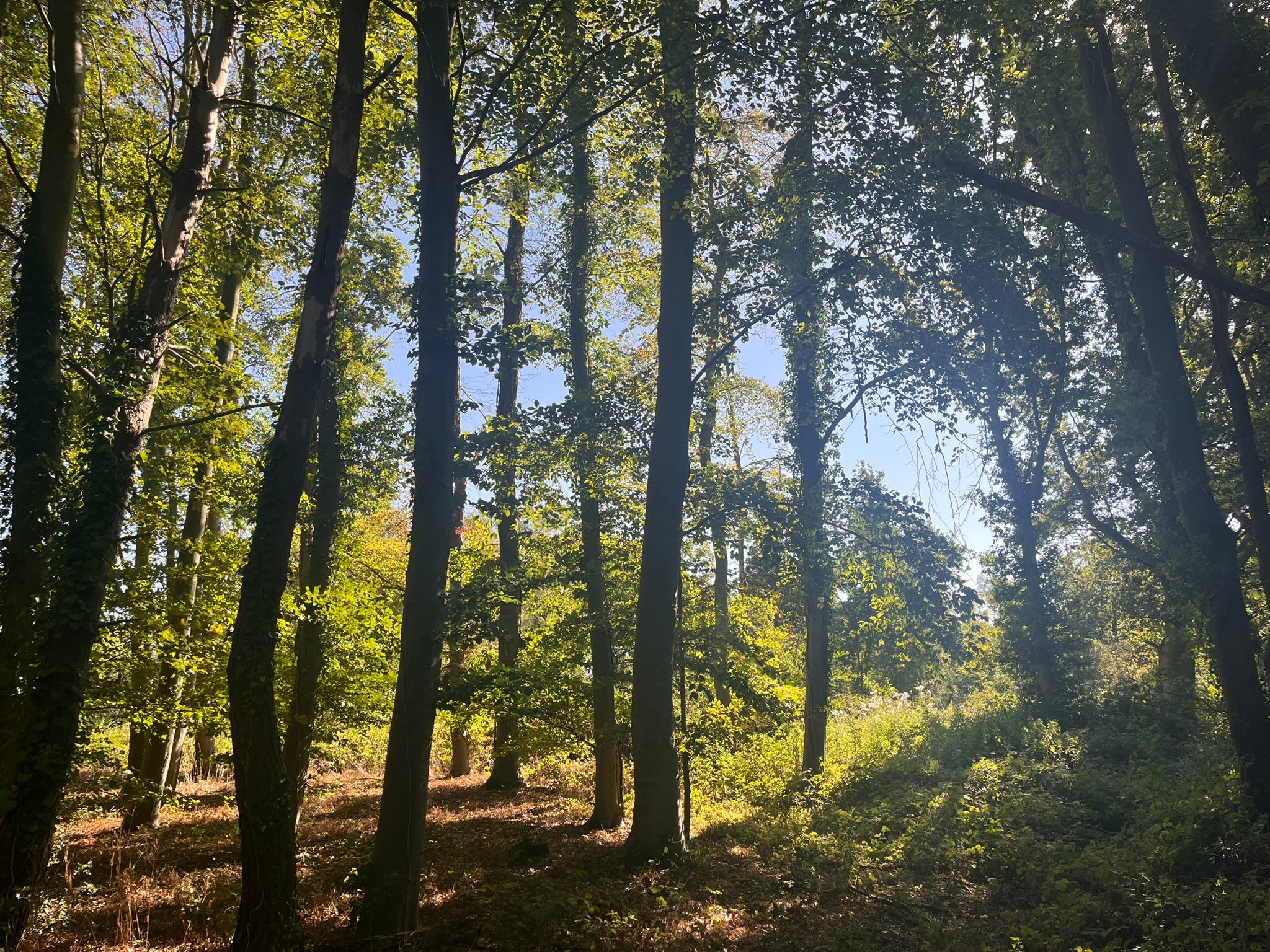
I walk a reverse of yesterday’s walk. A pair of buzzards are circuiting the fields close to “Barking Wood”. I hear them before I see them. Cat-like cries. Communicative. They seem to be calling to keep tabs on each other. Then I see them gently wheeling and gliding, hardly beating their wings. The woods are aglow with morning light, but they are quiet except for the soft calls of collared doves and the harsh rasp of jays. I keep my footsteps soft enough on the path for the dogs not to start barking until I’m past their fence. They sound like Cerberus when they do.
The hedgerow fruit is swelling and ripening. The first crab apples are beginning to drop. Even the sloes and haw-berries are beginning to turn their familiar colours. Everything feels too early. As I return to the village, the sun is starting to warm my arms and neck. Small clouds are beginning to form. A pair of F-35s make a hollow thunder overhead.
I work some more on the writing project and suddenly the first chapter is there, pieced together from existing elements. The second chapter will be more of a problem. I started on it some years ago, but it didn’t feel right. I think I know the solutions now. I read it, edit it, and separate it out into a new document to work on, though much of the day is spent staring at it, trying to figure out the best way to break it so that I can begin to grow it.
The magpie returns, tapping on the glass of the kitchen doors, looking in with a tilt of its head.
About ‘This Party’s Over’
On ‘This Party’s Over’ I publish my creative non-fiction, personal essays, place writing, and a country diary. My ‘Another Country Diary’ pieces are my most regular posts (about three or four a month).
The country diary can express a sort of local distinctiveness, explore a personal set of interactions with a landscape, and in doing so, almost accidentally, tease out the way the natural world is entwined with culture and politics. It can be a quietly radical and uncanny form, or sometimes just plain parochial, oddball in its specificity.
If you enjoyed this post, then follow the link below to the last one to read more, and, if you are feeling in the mood to, like, share, and subscribe. I love it when reader’s show their appreciation!
Upgrade to paid for full access to the archive and to the ‘Root and Branch Nature Writing’ series.
