
Another Country Diary #52
With bells and drizzle and a poem by William Barnes.


18/01/26
I am in York waiting in the drizzle outside the minster. The bells are ringing, calling people to Sunday worship. I am waiting for my daughter to meet me for breakfast. A deep and resonant cascade of notes falls from the bell tower. There is a statue of Emperor Constantin, who was declared Emperor near here, some seventeen hundred years ago. It’s dizzying how old our cities can be, once you peel back the layers.
My daughter shows me a second hand bookshop in the lanes. It is closed. A narrow bookshop on many floors in what might be a Tudor building. In the window a print of a woodcut catches my eye. It is of two coppice workers busy cutting the growth off a coppice stool, their work half done.1 I say coppice stool, but it is more of a pollard that has been cut at perhaps chest height. They wear flat caps and country suits, jackets off, sleeves rolled. A ladder is leaned against one of the stools. One of them has their billhook raised. Hills climb the horizon. Woods and hedgerows climb the fields. It stirs something visceral in me. My billhook is a prized possession, one of the most useful tools to keep handy in the woods. The picture reminds me of watching the layering the hazel hedges at my childhood home in Dorset by a man dressed the same way as these two workers. An old hazel man, a hedge and coppice man, who spoke the dialect of William Barnes, as many still did then in the Blackmore Vale, and insisted in being paid with chewing tobacco or brandy.
William Barnes wrote about such work in ‘The Hedger’, which I’ve quoted below. I love the way this poem moves from the meditative concentration of the work, “wi’ noo sound there/ but my own strokes, an’ chirpèn birds”, through the passing of time, that “slow-wheel’d plough”, towards a mood of melancholic remembrance and loss, ‘but vew/Be now a-left behine’, but also of the love that has ‘a-kept my path o’ life’ . The final lines provide a temporal layering with ‘her mother’s lwoad’ speaking of the wife as a maid, helping her mother (echoing the lines found in the middle of the poem), and as a wife, with her domestic burdens, and also of pregnancy; a parallel for the hedger’s cyclical, largely uncelebrated, but vital intergenerational work. 2
Upon the hedge theäse bank did bear,
Wi’ lwonesome thought untwold in words,
I woonce did work, wi’ noo sound there
But my own strokes, an’ chirpèn birds;
As down the west the zun went wan,
An’ days brought on our Zunday’s rest,
When sounds o’ cheemèn bells did vill
The aïr, an’ hook an’ axe wer stïll.
Along the wold town-path vo’k went,
An’ met unknown, or friend wi’ friend,
The maïd her busy mother zent,
The mother wi’ noo maïd to zend;
An’ in the light the gleäzier’s glass,
As he did pass, wer dazzlèn bright,
Or woone went by wï’ down-cast head,
A wrapp’d in blackness vor the dead.
An’ then the bank, wi’ risèn back,
That’s now a-most a-troddèn down,
Bore thorns wi’ rind o’ sheeny black,
An’ meäple stems o’ ribby brown;
An’ in the lewth o’ theäse tree heads,
Wer primrwose beds a-sprung in blooth,
An’ here a geäte, a-slammèn to,
Did let the slow-wheel’d plough roll drough.
Ov all that then went by, but vew
Be now a-left behine’, to beät
The mornèn flow’rs or evenèn dew,
Or slam the woakèn vive-bar’d geäte;
But woone, my wife, so litty-stepp’d,
That have a-kept my path o’ life,
Wi’ her vew errands on the road,
Where woonce she bore her mother’s lwoad.
The drive home takes me across the Lincolnshire flats. The roads are terrible. Not the usual rutted minor roads, but the main road, the A-17, is full of potholes and ruts, so that you have to keep your wits not to end up upside down in one of the deep drainage channels than run in places alongside the raised tarmac.
19/01
I’m looking after a sick hen. She is our eldest hen, our matriarch. We don’t know how old she is, but she came with the house, and was apparently already mature even then. She is probably dying, and though we have confidently predicted her death for the last few winters, it does seem as though she is on her last legs. She is struggling to perch. I get her to eat a few titbits, chopped veggies and cheese and corn, but before too long the younger hens crowd in.
I have an impossible week. I try to take on one task at a time, but whenever I pause to check my email, I found another slew of messages that need sorting and prioritising. I feel the pressure build until, by mid afternoon, it is a tight ball in my chest. I take the ball out into the fields in the hope that air and movement will massage it away. I walk up to the barking woods and back, along the muddy rain soaked track. The sky is mottled with altocumulus. The air feels damp and I regret not bringing gloves. I can see the flashing amber light on the top of a tractor as it cuts the hedges in the lanes. The sound of traffic from the main roads drifts across the fields.

23/01
The week somehow comes to an end, and although I still have some reading and preparation to do over the weekend, and fragments of admin that will haunt me into next week, I am less overwhelmed. Even so, I feel worn down. Not just the work, but the daily horror of Trump’s America seeping in like a disease. When him and his ilk are finally removed from power we will all need to be purged somehow. Leeches. Lancets. A long walk by the sea.
We go for a post-lunch walk in a drizzle that gradually develops into rain. The hedges and verges have been trimmed leaving the lanes feeling stripped back and bare boned. Even so, there are signs of spring. The bright yellow flowers of winter aconite wink up from the cut grass beneath the hedge.
A robin bustles in the hedge, seeking shelter. In places there is still food for birds; the berries of the ivy and rosehip that was deep enough for the blades to miss. A couple of Red Kites wheel and slow glide over the field next to the road.
At the top the rain comes on harder and is carried fast across the open fields. I’m glad of my gloves, and we both pull our hoods up close against the driving rain.
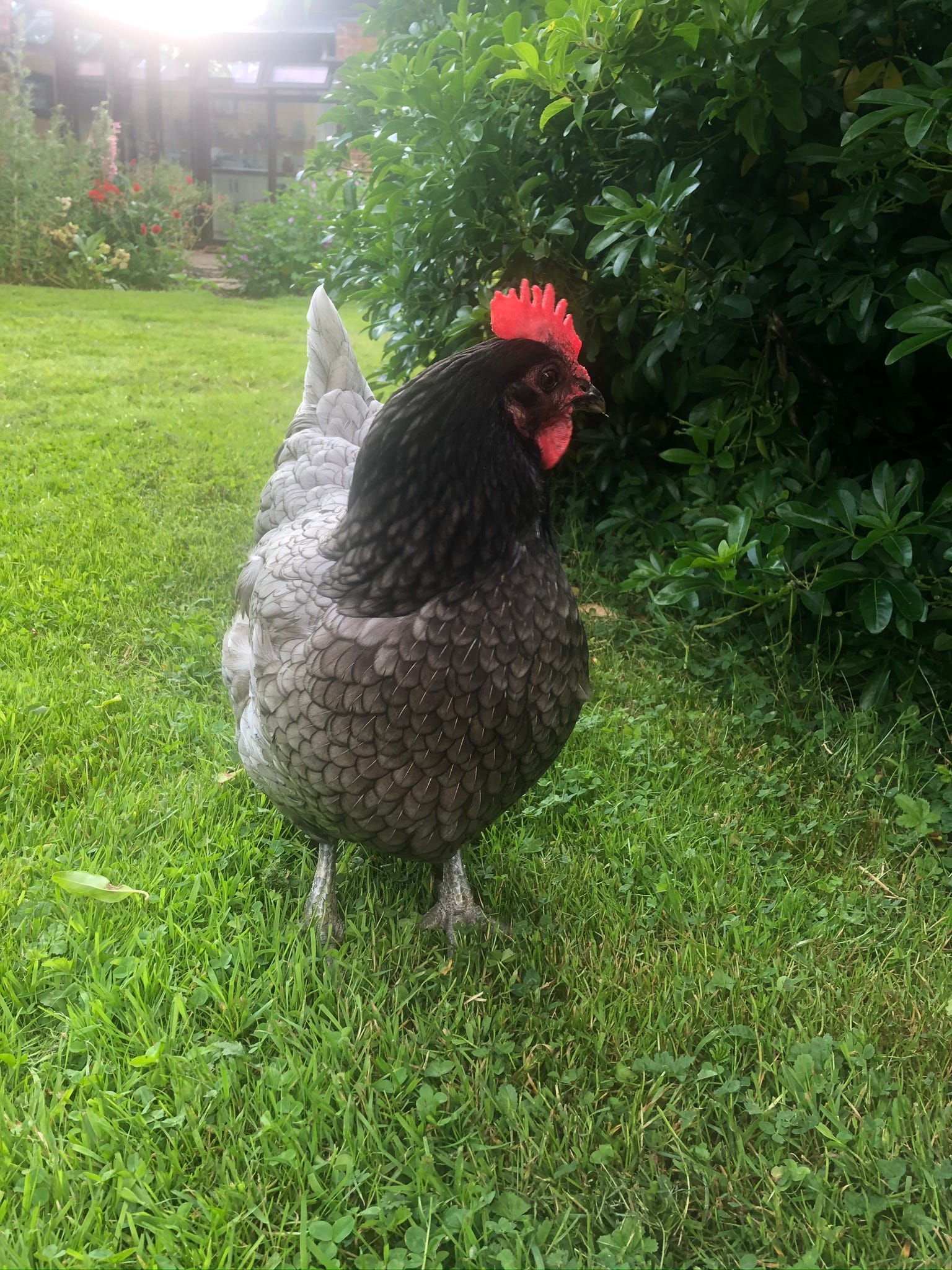
Mrs Wintersea, our oldest hen, the matriarch, and at one point the layer of largest and best eggs for cakes, finally passed away. We bury her in a shoebox amongst the elders in the copse. There are snowdrops in bloom under the ancient plum tree.
24/01
The day is cold and bright. The sky is empty of cloud all morning.
I’m reminded that we are more than half way through winter, that spring and growth will return. The promise of rebirth coursing like a pulse beneath the bark of trees. Buds slowly swelling. The death of winter only ever temporary.
I work for a couple of hours in the morning but for the most part I’m able to rest. It is the first day in weeks that I haven’t driven somewhere. The oil is delivered for our boiler. The hose is just long enough to reach, but it is a struggle. The delivery explains that the hose contains 100 litres of kerosene, so that he is pulling the weight of both the fuel and the hose. He has the biceps of a sailor.
On our walk we see five red kites above the lanes. They seem to be circling around the ancient hedge oak, probably with a mind to roosting in it. The sun is low, and we are close to the last hour of daylight. One of them glides low over a group of ravens in the field and sends them flying, presumably to get a look at what they were eating. The kite doesn’t seem bothered by whatever it was and wheels back to the group.
The sounds of machines seem to pursue us. A private helicopter passes over twice, blades slapping the air. The horn of a train on the mainline. Badly muffled exhausts fart on the B roads. The distant sighing of hundreds of tyres on the A roads. Sometimes I yearn for the uncanny machine silence of lockdown and the way birdsong swelled to fill it.
25/01
More death in Minnesota. More protest and resistance. There are echoes of the civil rights movement and anti-Vietnam war protests of the sixties and seventies, and more recently, of the Black Lives Matter protests.
There is a bank of snowdrops and winter aconite along the footpath next to the old orchard. A wren sings somewhere under the old plum trees. We walk in the afternoon murk under a low and indistinct mass of cloud that seems to be thinning from the north. A cold night coming perhaps.
The mud on the track is slippery, the patterns left by tractor tyres half-filled with yellowish water. In ‘Barking Woods’, now that the understorey is so low, the long hulks of the ash trees that fell five winters ago can be seen, piled up in places to create a wild and messy woodland-edge, or lying where they fell, mossed over, living their second life in decay.
About ‘This Party’s Over’
On ‘This Party’s Over’ I publish my creative non-fiction, personal essays, place writing, and a country diary. My ‘Another Country Diary’ pieces are my most regular posts (about three or four a month).
The country diary can express a sort of local distinctiveness, explore a personal set of interactions with a landscape, and in doing so, almost accidentally, tease out the way the natural world is entwined with culture and politics. It can be a quietly radical and uncanny form, or sometimes just plain parochial, oddball in its specificity.
If you enjoyed this post, then follow the link below to the last one to read more, and, if you are feeling in the mood to, like, share, and subscribe for free.
Upgrade to paid for full access to the archive and to the ‘Root and Branch Nature Writing’ series.
I wrote to the bookshop to find out about the print. It is by Clare Leighton and is titled ‘February, Lopping’, one from a set of twelve images from The Farmer’s Year, 1933.
I wrote more about William Barnes and my childhood home here: Another Country Diary #34
Wiiliam Barnes is new to me. Thank you for the introduction.
Condolences on the passing of Mrs Wintersea: I am sure she will be much missed.
Congratulations on finding the Clare Leighton… – I have been an avid admirer of her work for years, and have the book that print appears in: you describe it perfectly.