
Two Woods

The writing below was originally intended for Another Country Diary, but there was a connectedness and coherence that lent itself to a kind of epistolary essay in two parts.
You will notice that this post is for paid subscribers, but it has a generous free preview up to about half way. If you want to read the rest (a further 1,350 words) and find out whether I encounter the ‘babes in the wood’ at Wayland Wood, then please consider upgrading to a paid subscription.
01/08/2026 - Wensum Valley
A wood in drought feels like a tense place to be. All around me are highly flammable materials. Every footstep comes with a crunch, dry leaves, dry twigs. The dried-out husks of garlic mustard gone to seed are everywhere. Dotted about, the remains of fallen trees, left in situ for the wildlife, but now looking like wildfire fuel. It is early morning. I was supposed to be here last night with the bat conservation scientists who have been conducting a long term survey in these woods, but the all the roads I used to take to the woods in the Wensum Valley have been closed off due to a weekend of work on the A47 dualling, and more permanent closures of minor roads that once led off the same main road, and I became so flummoxed by the cones and diversions that I ended up turning the car around. The new section of road, which is vaster and more destructive than I ever could have imagined, was designed to link up to the now cancelled Norwich Western Link, the road that would have run straight through the section of woodland I’m walking in. The wildfires, including the huge blaze that appears to have destroyed completely the National Trust owned Dunwich Heath and part of RSPB Minsmere, are much on my mind. The natural world seems imperilled on every front.
The wood is quiet but for the rasping of rooks and the mewling of a pair of buzzards I had disturbed on my arrival. I’m glad that I worked out a route for getting here, twice as long as it used to be, though annoyed with myself that it hadn’t occurred to me last night. The woods have a deep shadiness, an impression of moving light, of shifting shapes. It possesses a submarine quality. An interplay of bright watery sunshine and fluid shadows. From the track near the entrance, I can see a partly cut field of barley. There is a brown shape, like a cat curled up, on the field margin. I move closer, picking my way over fallen branches and tangles of bramble. Through my binoculars I see it is a hare crouching. I watch it for a while and then retrace my steps to the track. A movement in the corner of my eye and I turn to see that it is running, alert now to my noise, and seeking to find distance (how far? a spear’s throw? an arrow’s shot? how hard-wired is their knowledge of our violence and destruction?).
I’m here to visit the section of woodland I’ve owned jointly with Ceci for a decade. We seem to have fewer opportunities to visit it these days. Our jobs are busy, our weekends frequently swamped by the overspill of our work lives. The forestry track betrays the lack of use. It is becoming overgrown with saplings and nettles. It wouldn’t be so bad if there were more people coming up here, but the council, when they were wanting to build the Norwich Western Link, bought out several of the owners of the surrounding woodland parcels. We, and a couple of others, held out, and now my parcel is surrounded by council-owned land.
I arrive at the stag oak. It is an impressive beast. I named it as such when we began to campaign on social media to save the woods from the road. It struck me that it was easier for people to relate to a tree if it had a name, an image, a brand. The tree sits on a low earth bank that marks an ancient parish boundary. This added height, through slight, is enough to make it seem imposing. It has a crown of many branches, including some that are broken and jagged like antlers. Stag oak it was. It became the backdrop of social media videos and interviews with the press. Politicians came to meet it. It is probably about 250 years old. A veteran on its way to becoming ancient. I stand beneath it and think of the ten years I have known it, and of how it has patiently outwaited all the fuss of the road, and of how, with luck, it will outwait me and outwait everyone I know. Woods beat to a different, slower pulse.
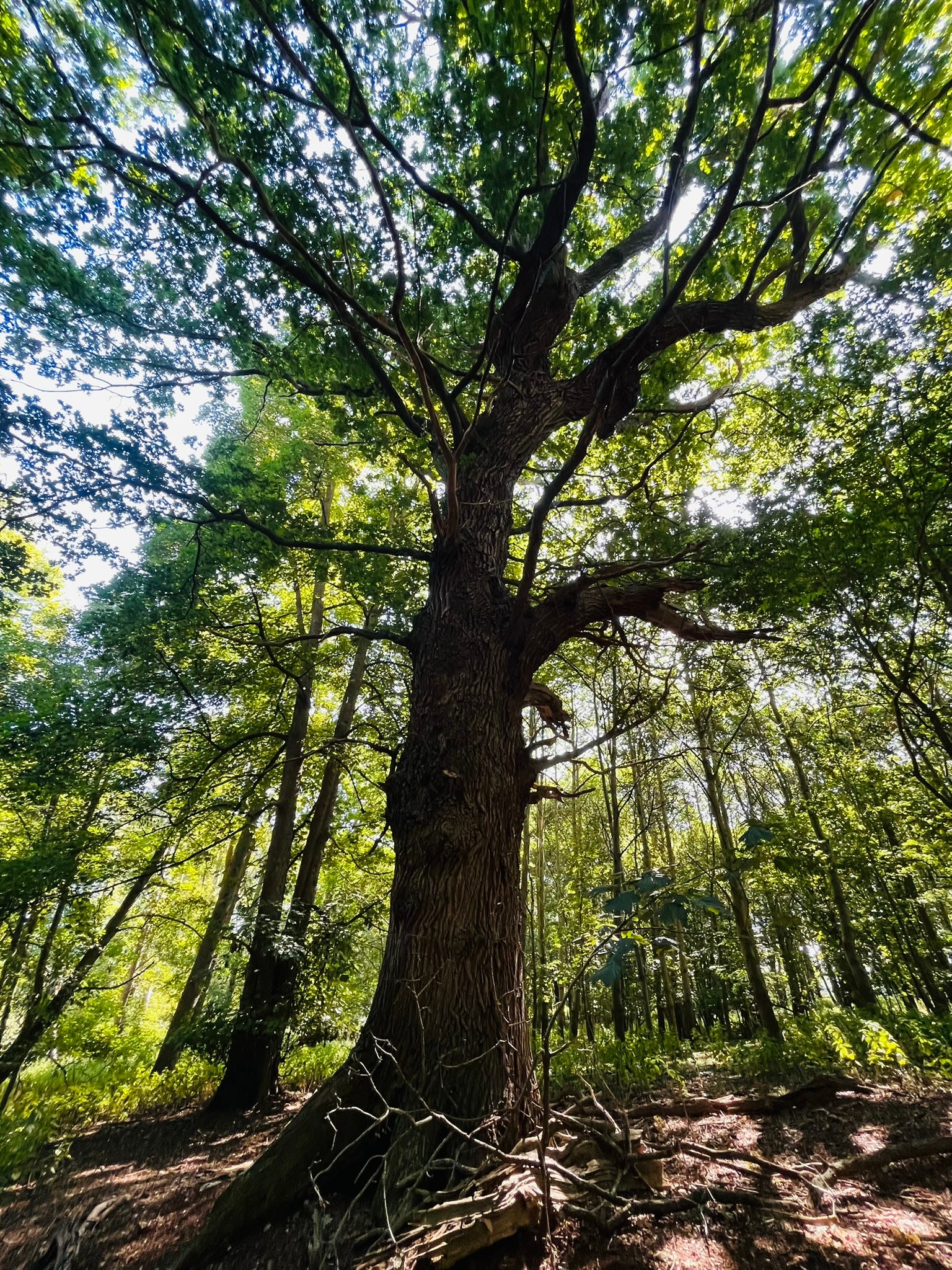
I follow the path, or what I can trace of it, into the wood. It is a roughly 4 acre parcel, part of a larger area of about four times that. One half of that area is on lower ground, and is more of a carr, a wet woodland that floods during winter from the Wensum flood plain. Our parcel is on slightly higher ground, and is a mix of old growth boundary oaks, nineteenth century oak and beech planting (with a few surviving ash), and twentieth century deciduous planting (a mix of oak, chestnut, and sycamore), with some old hazel coppice in the mix. It is linked by a 120-year-old pine plantation to a larger area ancient woodland. I come to a line of old oaks marking the parish boundary. There is an arable field beyond, not yet harvested. I’m not sure what crop it is, but the ears are small and still ripening. Spelt perhaps. Unusual in this hot summer of early harvests. Among the boundary oaks is another old friend, the fairy tree, so named for the games my daughters played around it when they were younger. It is ancient, over four hundred years old, a tree that has been coppiced in the past, and as grown with three broad trunks. I step out of the trees and onto the field margin, following it around the edge of the wood, noting the condition of the boundary oaks. I find fresh entrances at the badger sett, signs of digging.
When I reach another familiar tree, a veteran oak that always reminds me of an elephant for the tough curve of its bark, I step back into the wood, bending low beneath the branches of a young sycamore. The barn owl seems to fall from somewhere directly above my head. An impression of wings. For a moment it is at head height, then gliding up from the energy of its dive, and with a leisurely wing beat, onto the branch of a beech tree. No sound. Not even a whisper. I’ve long suspected that the elephant oak was used by owls. If I was an owl, I would use it. It has hollows and platforms. It is the sort of tree that owls in children’s picture books would use. The owl rotates its head towards me. I raise my binoculars for a better look, and at this point, it rises back into the air, sailing off into the carr. Like the hare, it would rather establish as much distance as possible from me. Wild barn owls, it would appear, have a low tolerance for owl friendly humans.
