
Another Country Diary #68
With a peregrine and a kestrel.


9/8/2026
I’m out walking later than I’d hoped. I didn’t get to bed until 1 am because I was waiting for Benji the cat to come home. We don’t have a cat flap, and ever since he was hit by a car we don’t like him to stay out over night. I was about to give up and go to bed when he arrived like a ghost against the glass of the kitchen door. The net result is that I rose later. I let out and fed the hens. Mucked them out and changed their straw. Fed the cats. So that by the time all this was done, the warmth was creeping into the day.
The brief cool spell at the end of last week has given way to another wave of heat. These peaks and troughs of extreme heat are forecast to last until at least next weekend. The morning is calm. The sunshine intense. The sky is Wedgewood blue. I bump into a neighbour walking her elderly dog. The dog can only get as far as the end of the lane and back, and is very slow. It doesn’t walk with the younger dogs anymore, but it is happy to move at its own pace.
The good thing about Sundays at this time is the lack of through traffic on the lanes. Instead, dragonflies zip back and forth between the hedges at head height, catching midges and other small insects. Where the lane becomes the track up to “the top” I disturb a family of partridges crossing from one hedge to the other. Four run across, and a couple of others remain on the other side, and hide in the thick stems of the verge. A hare in a field entrance, catches sight of me a little late and makes a panicked dash into the long grass of the field margin. Further up the track, a rabbit gazes at me, then runs up the track, using the verges as cover, past the old farmhouse, and on towards its burrow in the hollow.
On the way back, I pick blackberries. Nearly all the brambles in the hedges have their first ripened fruit, though the majority of the berries are still red or green. I pick the largest, pausing every so often at bushes all the way home. There are hundreds of bushes, and each bush has hundreds of berries, so although I’m always careful about only picking a few from each bush, I’m not concerned that such picking impacts wildlife. It is not like an urban or suburban space, where such fruiting hedgerows are less common and tend to be overused by both foragers and wildlife. I have enough for a couple of overly pricey and small punnets of the sort sold in supermarkets by the time I get home.
10/8
I arrive at the wood at about 9.30, early enough, I figure, for it to still have some of the energy of morning. I woke early, unable to sleep due to the heat, but the day is cool and overcast in that way that will slowly break into sunshine. There are hares in the stubble of the field adjacent to the track into the wood. One is cleaning when he notices me. I am standing inside the wood, a fence and about thirty metres between us. He eyes me, and then moves a couple of metres further away, crouching low at first, then sitting up. I move further up the track and spot another hare, hunched in the field margin, it startles and runs.
I follow the track up into the ancient part of the wood. One of the larger beeches is dropping its leaves. The flutter down like an early autumn fall. A sign of distress. Where they grow, the nettles look straggly and parched. In wetter years they would be thicker, collapsing on each other from the weight of their growth. A couple of muntjac deer crash through understory, running deeper into the trees. I move off the track and follow a badger track through an area of woodland that is a sea of bluebells in the spring. It is full of mature oak, lime, and ash, and is pleasingly untidy, with oaks in various states of decay, standing of fallen, giving the wood an untamed appearance. This is once of the reasons it is also great bat habitat. The broken trees, with their loose bark, and fissured trunks, make for ideal roosts.
I return to the track, following it towards our patch, slightly downhill as the ground begins to slope towards the Wensum floodplain. I can feel my senses opening. The wood seems to do this to me, create a heightened awareness of movement and sound. I’m just about to enter an area of woodland that would have been completely obliterated by the construction corridor of the now cancelled route of the Norwich Western Link when I hear a highish keening call, repeating over and again. I’ve heard it before, and I had so strongly suspected that it was a Peregrine falcon, that I had gone home and listened to as many recordings as I could find. So this time I’m certain. Even so, I whip out my phone and flick on the Merlin app. At once it confirms my suspicion. It is somewhere overhead. I can hear the call move behind me, then to my right over the field. I look in that direction and see the pale flash of what I think is its body, before I lose sight.
Onward then, and into my section of wood. I notice a few changes, most notably a veteran field maple which has been coppiced in the past. It sits on the bank that marks the parish boundary. One of its main stems has split off the others. It is one I recorded for the ancient tree inventory (though I’m not sure if it was ever registered) and I had noted at the time the hollow that had formed where the stems met. The hollow is now fully exposed, and is, I would think, a most tremendous micro-habitat. There is water inside it and no doubt a great deal of microbial activity. In the lower part of the wood, close by the carr, I find the remains of a woodpigeon—just the feathers really. It is positioned beneath a tripod that has occurred naturally as a result of falling branches. It almost looks ritualistically staged.
I have a camping chair with me, and I spend some twenty minutes, maybe longer, just sitting beneath an old hazel, listening. The traffic noise of the Northern Broadway is a constant, and it’s about a kilometre away, on the other side of the Wensum. It is a distracting sound, and tends drown out other sounds until I can tune my ear. The din of traffic is all pervasive in most of England, though on a good day, with the wind in the other direction, it can be silent in this wood, and it was quieter still before the Broadway was completed in 2018. The heat maps for the predicted noise impacts of the Norwich Western Link were shocking—a set of flaming reds and oranges. Nothing would want to to breed or nest in such an environment. Even without the impacts of habitat fragmentation and roadkill, the noise alone would have severely impacted biodiversity. If I feel stressed with the sound of traffic a kilometre away, imagine being a wood mouse or a barn owl living right next to it.
A light aeroplane passes overhead. Still more man-made noise. Then the alarm call of a great tit, alert to me perhaps. A hare running—I catch a flash of it moving between the nettles. Rooks, abrasive—louder, I realise, than the sound of the distant traffic. Closer. A collared dove, from somewhere to my right. The sunlight comes and goes in pools of light that suddenly vanish. I notice the wind in the high leaves. A shimmering sound. At ground level, the nettles sway a little, also shaking their leaves. A jay squarks somewhere up ahead.
I’m grateful that the wood is still here, and that I can still come to it. Sad also, that I don’t come as often as I used to, that the imbalance between my working life and what is good for me has become so evident.


On my way out of the wood, I hear the peregrine again. I am in a different part of the wood, and its call carries over the field in which I saw the hares earlier. I push my way to the woodland edge, binoculars in hand, but before I have time to raise them I see it flash by on a near collision course with a buzzard coming in the other direction. They cross in the air. It looks deliberate. Territorial perhaps. The peregrine rises up to the right, over woodland, then I track it as it flies with rapid wing beats for the wooded ridge on the other side of the nearby lane. The buzzard has circled back over the woods I am in, and I can heard it calling behind me as I walk down the track to where I’ve left my car.
11/8
The wind feels warm and dry as I walk up to the top. The seasonal palettes seem all wrong, too many shades of brown. The stiff, dried architecture of cow parsley and wild carrot in the verges, against a grass that has been bleached to the palest imaginable shade of yellow. The field I’m walking past, a meadow, looks dry enough to self-combust. A pair of muntjacs, a mother and a juvenile, cross the lane ahead of me and disappear into the long grass, following a well used track through the hedge and across the ditch.
There is a village in Cambridgeshire, Histon, which has recorded less that 200mm of rain since January 1st. I can feel the sun’s strength on my bare arms. The blue sky contains some herringbone clouds, but the heat dome is still firmly lodged. A further heatwave is set from tomorrow onwards. We’ve fared a little better here. A little over tow weeks ago it rained overnight, a series of heavy showers, but that had been the first rain in many weeks. It isn’t enough to replenish the depleted water table or to sate the thirst of the parched soil. The climate deniers like to talk about 1976, about how that year was worse. Of course, it wasn’t. And in any case the long hot summer of 1976 was both relatively localised and was considered an anomalous event. This summer there have been heat domes all over the northern hemisphere, and this dry summer is happening in the context of ever warmer average temperatures. I try not to be a climate doomer, but the silver linings of this particular cloud feel hard to locate. I read a Forbes article about the curious way our leaders are retreating from climate action at the very point it is most needed. It equates climate breakdown to the unbearable truth of a serious medical diagnosis. Patients misjudge the prognosis, deny the seriousness of their situation, or seek life-saving interventions too late. Leaders deny the diagnosis (it isn’t happening), then the cause of the crisis (it’s a disaster, but not man-made), then the treatment (the necessary policies cost too much financially or politically), then the responsibility (its not their fault, somebody else has to act, not them). We are probably, mostly, in the last two stages of denial when it comes to our current leaders. In an ‘Ideas’ podcast (CBC Radio) about wildfires that I listened to over breakfast, one of the interviewees, a projects coordinator for the St’at’imc first nation government, Nina Andrasic, described the wildfire situation in Canada as ‘a chronic illness in our landscapes’. The sickness metaphor again. Her point is that with a chronic illness it pays to wait and listen to the body before rushing to a treatment that might be wrong. In this case, she is talking in particular about land management, the increased risk of forest fires, and the recovery of habitats following a fire. That we need to adapt our ways in order to meet the demands of the illness and heal the body, such as drawing on indigenous knowledge of land management rather than colonial techniques which exacerbate the problem (intensively forestry); is a fair point to make. But I’m left wondering then about this sickness metaphor. It seems to be that we have both an acute and a chronic prognosis. The acute illness, the escalating climate emergency, demands immediate and drastic treatment—bold policies, visionary leadership, global coordination, community initiatives—to mitigate the potential for a worsening situation. The chronic prognosis—that we will not be able to reverse the damage already done within the next few generations—requires a more measured response, one of adaptation towards a long time future in which we learn to live with the illness without it killing us.
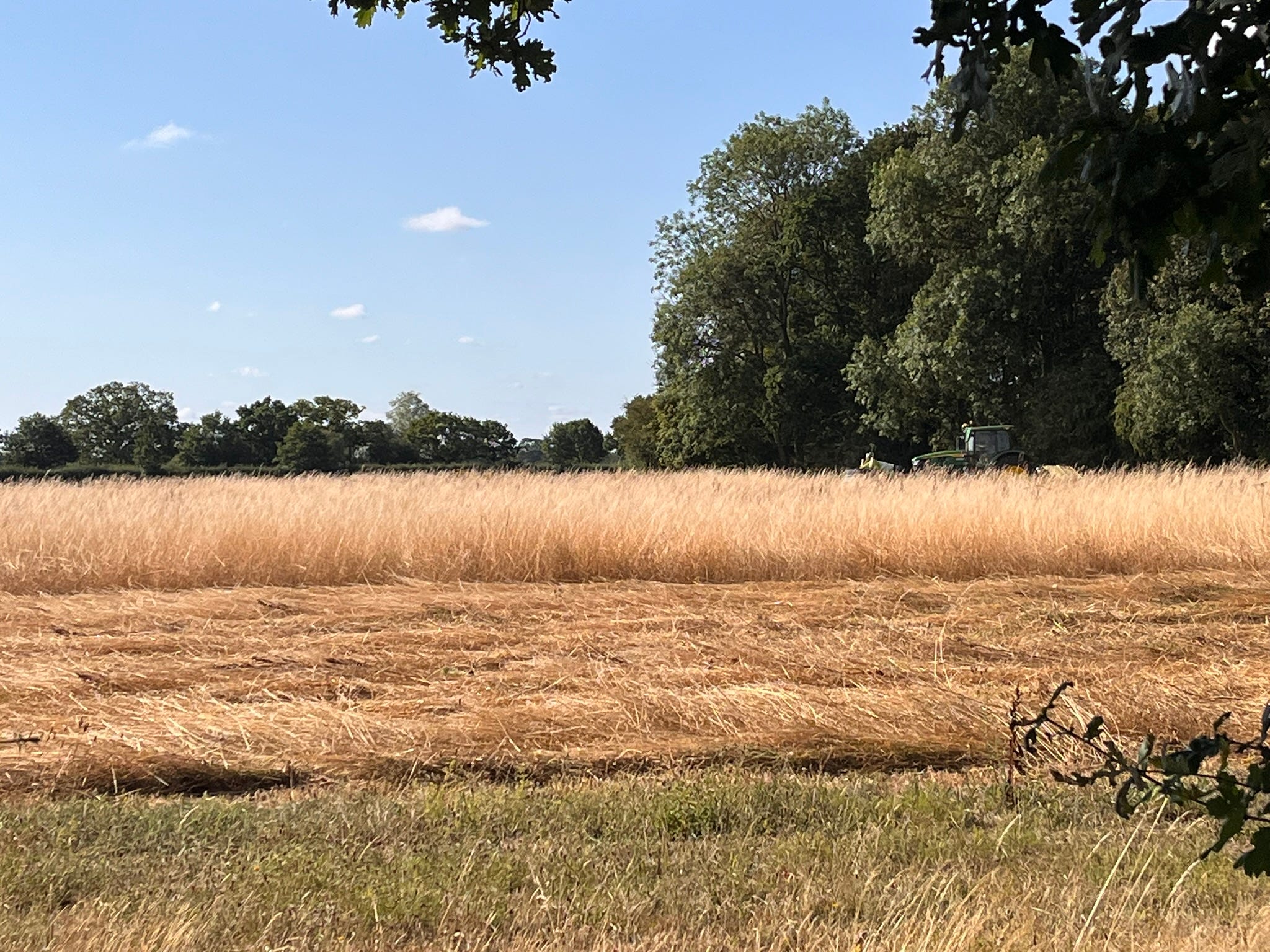
I walk back through the lanes lost in thought. So much so, that I forget to pick blackberries until I’m already past the best row of bramble bushes. By the time I reach the meadow field, I find that it is being cut. A tractor is mowing it. Part of the field had been grown for silage, and that grass sits green and clumpy where it has been cut, but the corner of the field that has been left as meadow is as dry as straw. At least it is less likely to burn, I find myself thinking.
12/8
The silage has been baled and wrapped in black plastic. The plastic shines darkly in the morning sun. There are about four large fields that have been cut and baled. The cut meadow grass has been left unbaled as it is far too dry to use. I wonder what they will do with it. It seems too fine to use as straw. A pair of hares run diagonally across the field, over the cut grass. One turns on its heels, racing to the field margin, and bounding away from where I’m standing at the field entrance. The second is slow to follow. It turns, and seemingly confused, bounds towards me. I decide to move when it is about five metres from me, fearing that it might just run straight into my legs. As I side step, it jinks to my right, its feet drumming the dry earth of the field margin, and disappears after its companion.
It is good to see silage being made. This isn’t a livestock farm, but the farm manager must have gambled on feed being a valuable crop. With the summer we’re experiencing, that is very much the case. There are reports that many farmers have started to use their winter feed stocks.
On the way back, I hear a kestrel calling. It lands on the branch of a hedge oak, and rests there just long enough for me to fully appreciate the beauty if its plumage—sea-grey around the head, peachy-brown on the flight feather, a creamy underside, and everything speckled. It notices me and takes flight, landing on another hedge oak, then as I catch up with it, I hear it calling again, and flying directly to an field oak. Black-headed gulls are picking over the recently mowed field, and I wonder if the kestrel is there for the same reason, for the suddenly exposed voles, and the crickets, which seem to be plentiful this year.
Later, after lunch, I sit and watch a green woodpecker eating ants in the garden. It stands relatively tall in the uncut grass, picking and pecking with decisive jabs. The red cap bobbing with each movement. Other than the red, the green of its body camouflages well against the lawn. I go to water the plants. A pair of buzzards glide overhead, calling. I find their calls plaintive, oddly moving. I do the rounds with the heavy watering can, but it doesn’t feel like enough in this weather. The tomato plants are pretending to die, the courgettes wilting. Drama queens. I water them all.
Then the eclipse, only partial, but about 93% here in Norfolk. I only learned about it yesterday, and so it was far too lathe to order eclipse glasses. I make do with a colander to project the imagine, dozens of miniature suns against the wall. When we last had something like this, in August 1999, I was working in Trafalgar Square Waterstones, and I remember all the pigeons going to roost as the sky darkened. The effect is similarly uncanny this time. It is like an evening light, but not, because the angles from the sun are all wrong, and the quality of the light quite different. Pumba, our cat, stares up at the sky through the glass roof of the kitchen and mews repeatedly. As if he knows something is amiss.
The sun darkens, earth in ocean sinks, fall from heaven the bright stars, fire’s breath assails the all-nourishing tree, towering fire plays against heaven itself.
Science tells us it’s not the end of the world, that the sun will come back. It’s striking though just how many apocalyptic texts—the Völuspá (quoted above), the The Revelation of St John the Divine, and Mary Shelley’s The Last Man, to name a few—use the image of the sun going out to denote a coming catastrophe. As the fires rage across our forests and wild places, it’s difficult not to feel a murmur of that sentiment.
After dark, and I shut off all the lights in the house and walk out to the sun lounger, which I have pre-positioned in the centre of the lawn. I settle myself and shut off my headtorch. The night sky swims into view. I am star bathing in the pale wash of the milky way, the pin pricks of familiar constellations. Almost at once there is a bluish streak, directly overhead, then another, low on the horizon. The earth is moving through the a stream of debris left behind by Comet Swift-Tuttle, which last visited the solar system in 1992. This is the Perseid Meteor shower. I am a little early for it. The meteors are supposed to peak in the small hours, but I am content to watch the early show. I lie back and wait for more of the bright streaks, but what strikes me is the sheer number of man-made satellites passing overhead—tiny lights moving along their steady orbits. There is a steady stream of them. I stay out a while longer. More meteors, including some that flash brightly without a trail before winking out. I try in vain to catch one on my camera phone before going to bed.
13/8
The trees in “Barking Wood” are in distress. Some of the mature beeches are taking on autumnal hues and dropping their leaves. A hedgerow of young sycamore are also suffering. The birches are also not looking so good. This is a wood that usually had a pool or two of water in its heart, and in winter it is often very wet, but this summer has dried it out completely. I saw similar signs in the Wensum Valley earlier this week, a beech tree dropping leaves. What is striking is that these signs of extreme distress seem to have come on quite rapidly. I’m fairly certain they were not present last week. This is, I know, the trees’ natural response to a severe drought. I’m taking a shorter walk today, aiming to conserve my energy for the gruellingly hot day ahead. The trees are doing something similar. This weird autumn is a defence against drought. I worry though, that repeated shocks like this as out summers get ever hotter will change what out woodlands and our wildlife look like. Not all species will be able to adapt to the speed and severity of the change.
I walk back via the long hedgerow collecting blackberries as I go. The buzzards I saw yesterday are in the distance, circling over the next field. There are four. A family I would guess—parents and two juveniles.
The heat builds. The outside air feels like the kind of heat that comes from a overly hot stove. A hot breeze builds. All afternoon there are news reports, local and national, of wildfires. Norfolk Fire Brigade declare an emergency as they tackle 16 blazes at once. The New Forest is burning for the sixth day in a row.
At night, through the window, I glimpse a small fireball of a meteor spear across the northern horizon before it is lost to the darkness.

THANK YOU FOR READING! See below for more details about my Substack.
About This Party’s Over
In This Party’s Over, I’m building a sustained body of writing about the natural world, rural life, landscape, literature, and the crises we all face in these troubled times. My Another Country Diary pieces are my most regular posts (about three or four a month).
The country diary can express a sort of local distinctiveness, explore a personal set of interactions with a landscape, and in doing so, almost accidentally, tease out the way the natural world is entwined with culture and politics.
If you’ve been enjoying the free diaries, you can support the project by becoming a paid subscriber. Paid subscribers gain access to the full archive, including all country diary posts, my standalone essays, and the Root and Branch Nature Writing series of writing exercises. There is currently an offer of 20% off the first year of an annual subscription.
Upgrade to paid for full access to the archive and to the ‘Root and Branch Nature Writing’ series.