

1/7/26
July, the month that seems to consolidate all the growth of spring into a readying of fruit and seed. It weighs heavy in the boughs of the fruit trees and begins to swell in the hedges. I feel ready for annual leave, but still have a couple of weeks to go. By that time the first plums will be ready. The day flits by on emails, meetings, admin, and module design. After work I water the garden and take stock of the vegetable beds. I’m still behind on digging up the first early potatoes. the last few rows have given up and are beginning to yellow and fall back. I will dig them up this weekend. The second earlies are either flowering or a week or so past flowering, and so will need to be dug up soon. As the spuds come up, the squashes go in, but we have had fewer seedlings grow successfully this year, and will be short of plants. There is still just enough time to grow a few more courgette plants from seed and have them provide a late summer and early autumn crop.
At dusk, a flight of fighter jets rises wrapped in their own thunder. After nightfall, as I lock up the hens, male tawny owls fill black air with their hollow calls.
2/7
The morning is cool and cloudy. The wind wavers, rising and falling, causing the hollyhocks beyond the kitchen window to nod back and forth. Then the sun burns through. Bright July sunshine. A breeze taking the edge off the warmth. More emails and curriculum planning, but with a view of my garden. My eldest daughter, who has finished her work placement and is now fully on her long university break, keeps me company.
4/7
We attend a friend’s seventieth birthday, a joyous and moving occasion with song and food. We catch up with a few people we know tangentially from work and from the Stop the Wensum Link campaign. It feels good to be outside of the bubble of academic life for a few hours.
5/7
I wake to the sound of the rooks and jackdaws that have moved into the oak trees growing in the copse at the back of our house. They seem to have arrived about a week ago. I’m guessing that at this time of year, once fledglings have left the nest, the colonies disperse, move on from their nesting colonies, but I don’t know for certain. I can’t think of any other reason for their sudden arrival, except perhaps a colony grown too large for another site. I need to read Mark Cocker’s Crow Country again.
For the first time in weeks I don’t have any preparatory reading for teaching or supervisions. It feels liberatory. I celebrate by digging up the last of the first earlies, which are enough to fill up a large potato bag. I plant out another courgette plant. Other squashes and courgettes are coming along well in the greenhouse, and should be ready to plant out in a week or so. A little late, but there is still time for them to produce something for early autumn.
There is a family of green woodpeckers in the area. They seem to be roosting in the copse, and perhaps nested there. The juveniles are on the neighbour’s lawn, pecking at ants and whatever else they can find.
10/7
I drive up to York with my daughter. We are spending 24 hours moving her belongings from student halls to her second year house. The drive takes us through the landscape devastated by the dualling of the A47 close to Norwich. If it were simply dualling, it wouldn’t be so bad, but they have also built a link road of sorts designed to serve a food enterprise park, and seemingly endless associated roundabouts, so that the footprint of the project is vast. We used to take a beautiful lane to Ringland that cut deep down a hill towards where the A47 and the River Tudd ran as close neighbours, the road following the river valley. It was a narrow, little-used lane, with steep banks and high hedges. Kestrels would hover above it. Now it, and the hill it was on, simply no longer exist. Both have been excavated away. In its place is a roundabout in a cutting, with blanked off exits (presumably for future development). The little lane and its gentle hill have been bulldozed away, along with thousands of trees and miles of hedgerow. When it is all done, the road will be faster, so not really any safer. The whole area looks set to become a zone of commercial and residential development. The roads will soon fill up again. As we neared the end of the roadworks we passed a wide field of devastation. It seems to have been used as a dumping ground for earth from the project. It is striated with tracks and various pieces of roadbuilding wreckage, random concrete objects. The scarred earth has greened a little. Various intrepid species are pushing forth. Across this shattered landscape, picking its way between woodlands, is a stag. His red flanks are moving in the sunshine. His antlers dip and fall as he trots and bounds through the danger.
11/7
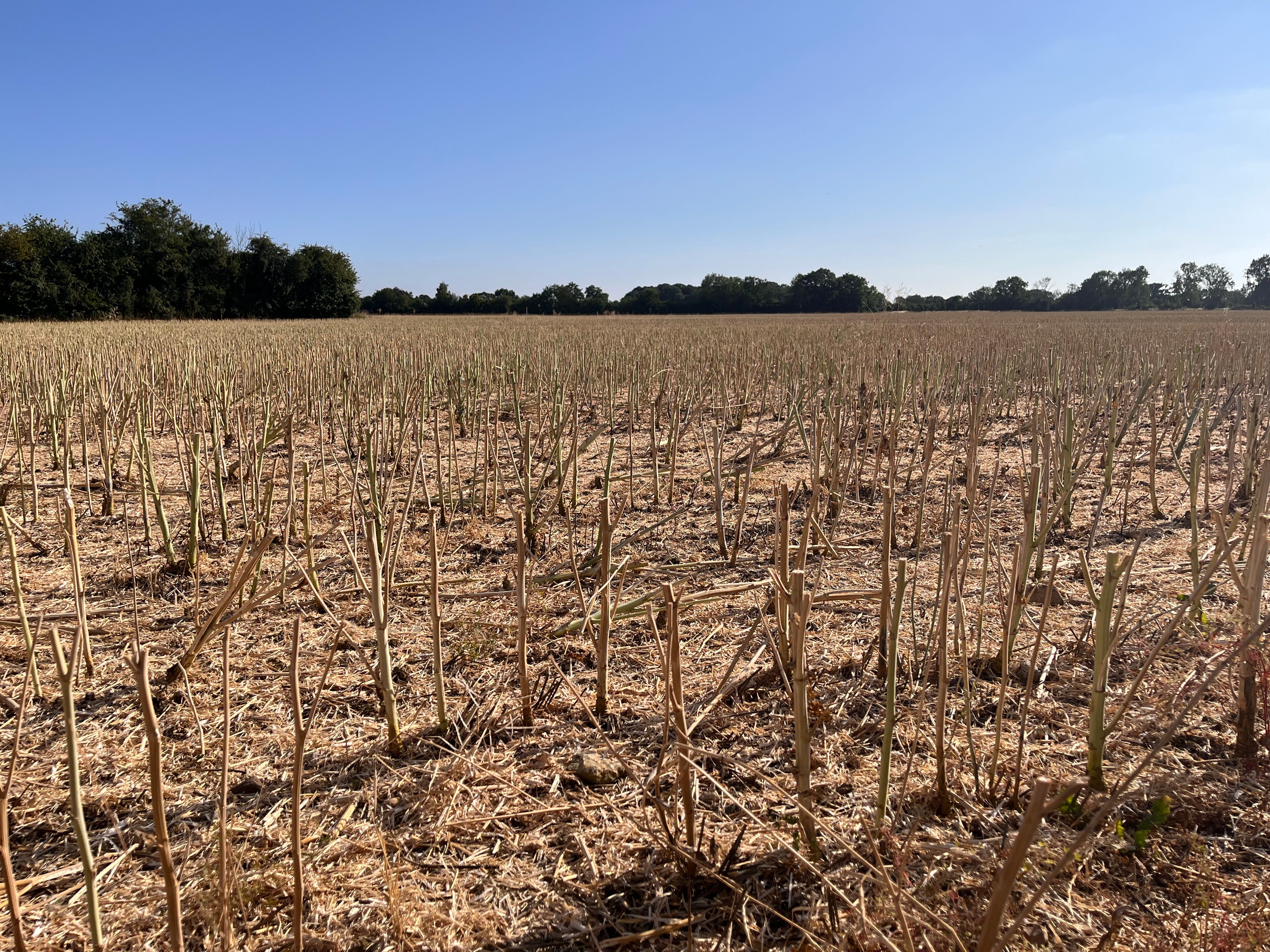
After the long drive back I walk with Ceci to ‘barking woods’ and back, taking the bridleway that runs the length of one long hedgerow between village and copse. It is good to stretch my legs and my back after four or five hours of cramped concentration behind the wheel. The rapeseed in the fields on either side has been harvested. I think they did it last week. It looks like a scene from a dustbowl movie, nothing but dry soil and the stalks of plants. The fruit in the hedges continue to swell: crab apples, blackberries, sloes, and damson. Butterflies seem to like this long corridor of habitat. There are meadow browns, small whites, tortoiseshells, and others I can’t identify.
12/7
All the new hens are now laying. This means we are getting an average of five eggs a day. It is a lot of eggs. Ceci has been gathering plums from the ancient tree in the copse. They are small, yellow-red fruits—too plentiful to eat. I can only manage six at a time, and we have two full punnets.
16/7
It has been hot and dry for the last two weeks. No rain. A hosepipe ban has been put in place, the first for over a decade in this region. Watering the vegetable beds and the more vulnerable shrubs and trees now takes an age as I struggle back and forth with a heavy watering can, spilling the contents on my shirt and trousers as I go. After a few days of this the old handle of the can gives out, and I have to carry it in both hands like a bowl. The beans have been flowering for weeks but have hardly produced any beans, and Ceci wonders whether it is because they are not being pollinated. There seem to be so few bees this year.
My daughter and I go to vote in the Police and Crime Commissioner by-election. It is her first time voting. We are the only ones there. We then walk up to the church. Molly the church cat is keeping cool in the shade of the porch. The walk back home takes us across a field of rye that looks ready to harvest. The earth of the footpath is cracked and dusty, baked hard by the sun.
About ‘This Party’s Over’
On ‘This Party’s Over’ I publish my creative non-fiction, personal essays, place writing, and a country diary. My ‘Another Country Diary’ pieces are my most regular posts (about three or four a month).
The country diary can express a sort of local distinctiveness, explore a personal set of interactions with a landscape, and in doing so, almost accidentally, tease out the way the natural world is entwined with culture and politics. It can be a quietly radical and uncanny form, or sometimes just plain parochial, oddball in its specificity.
If you enjoyed this post, then follow the link below to the last one to read more, and, if you are feeling in the mood to, like, share, and subscribe for free.
Upgrade to paid for full access to the archive and to the ‘Root and Branch Nature Writing’ series.
Another Country Diary #63

This Party's Over is a reader-supported publication. To receive new posts and support my work, consider becoming a free or paid subscriber.