
Another Country Diary #61
With a diner, a hedge portal, starlings, and a demolition


9/5/26
Zak’s Diner in Norwich is one of those places that has existed on the periphery of my vision and awareness for the two decades I have lived in the area. It flashes by when I drive on the inner ring road, hard to miss with its pink paintwork and bright signage. It started in the 1970s as a van selling freshly cooked burgers wrapped in foil, “American style”, to hungry drinkers after the pubs closed, and developed, over the years, into a small local chain offering a vintage Americana diner experience. My youngest daughter, via Lana Del Rey and Elvis Presley, is a fan of vintage Americana, and so we head out to it in the hope of taking lots of photos for use in her GCSE art project.
The diner is located next to the river, and so we park in the city and follow the Wensum riverside walk from Fye Bridge, alongside the old Quay Side, once a docks and now an Instagram opportunity with its pretty pastel painted buildings, over the road next to Whitefriars Bridge, then past the tall and impressive red brick St. James Mill along a section of the walk overshaded by weeping willows. It is a side of Norwich I don’t know well, and I have a strange sense of being somewhere on holiday as I take in this familiar city from new angles. We cross the river on the modern Jarrold’s foot bridge, leaving the main river walk, and following a walk on the other bank which goes past the back of some modern offices, a car park, a sports centre, and a row of buildings housing flats, until we reach the bank opposite Cow Tower, one of the surviving watch towers from the medieval defensive wall. Then we duck up an ally and find ourselves outside Zak’s.


We have our milkshakes listening to a playlist American rock-and-roll classics, and take in the assemblage of twentieth century cultural clutter on display—an easy Rider poster, an Elvis sign, adverts and signs for various beers, a large vintage gas pump—before taking photos and heading back along the river. I am again struck by the sense of being on holiday. The day is warming up pleasingly. Summer vibes. There are runners, not the puffing and wobbling park runners, but athletically fit runners, making use of the riverside space in a way that for some reason feels decidedly continental. Runners chatting in pairs. Elderly couples on benches. Harried looking fathers attempting to prevent their young sons from falling into the murky waters. How has this other Norwich existed under my nose, in a fold of undiscovered city, for so long without me visiting it?
10/5
The weather has changed. The grey skies of the morning have lifted to cumulus and sunshine, but the wind is cold as walk the lanes up to ‘the top’.
As we follow the path down towards the lower fields, a group of roe deer cross the field to our left diagonally, seemingly unaware of us until they are abreast us, at which point they quicken their pace. There are five of them. Two look fully mature, and the three others look younger and smaller. They vanish, one by one, through a hedge portal. It is one of several along that hedge, but it is the most used, with a clear track up and down the banks of the ditch, and the trees pushed out of the way to form a small arch. A hedge portal, because it is exactly that, though I can’t help but think that they are portals to an elsewhere, another time, a wild otherness. We catch up with them as we round the bottom of the hedge and walk along the edge of one of the lower fields. They are in the next field, separated from us by a ditch and about fifty metres of still green wheat. They trot a little further into the field. We can only see four now, but perhaps one has gone further, through another hedge, or else is laying low in the crops. The four we can see stand and watch us with great attention, and even once we have walked away, retracing out steps up the hill, we can see them watching us from below, waiting until the threat we represent has passed.


Along the track we are accompanied by skylarks singing into the wind. A buzzard glides against the air, swift clouds moving above it. In a field next to the lanes we catch sight of a tawny owl hunting in the day. The owl flies fast and low across the field, before dropping like a flint into the crops and onto whatever prey it had sighted. Further along the hedgerow, smaller in scale, a robin with a fat green caterpillar. There are hungry mouths to feed and the parents don’t rest in their search for it.
A pied wagtail hops along the tarmac. This little stretch of lane is the only place I have seen pied wagtails in the parish.
The rest of the day is spent reading for work. All other jobs go undone—the car unwashed, the grass unmown. If it rains again, cutting the grass will be a pain.
11/5
On my walk to my afternoon seminar, the last workshop of the year, I cross paths with a magpie. I’m not sure if it’s old or just unafraid, but it allows me close enough to see the glorious iridescence of its supposedly black plumage. If you get near these birds, you’ll see that the black feathers contain oily greens and blues. They are extraordinarily beautiful animals.
12/5
We pass a road-killed muntjac on the way into the village. It looks like the large pale-brown doe that has been visiting out garden.

16/5
The rapeseed is now sage-coloured, and will slowly bleach out in the sun in the coming weeks as the seedpods dry. The weather has been cold all week, struggling to get into double figures. Rain showers. The hot water bottles have been in use again, and yesterday, working from home, I resorted to lighting the woodburning stove and burning whatever leftover logs I had to keep the house from getting any colder. If it wasn’t for the long light evenings it would feel like November.
I mow the lawn before the rain that is forecast and then read in preparation for my supervisions on Monday. We buy half-price pots in the garden centre to replace those that have cracked over the winter.
17/5
After lunch we go for a long circular walk through the lanes, up to ‘the top’, along the lower fields, across ‘clay field’ an the the field ponds, then along another lane until we reach ‘barking woods’ an the footpath back to the village.
The verges are are constantly redressing themselves with wildflowers. We find a large patch of common vetch just outside the village. We identify three other flowering plats with the ‘Seek’ app. The dove’s-foot crane’s-bill, the hedgerow crane’s-bill, and the common star-of-Bethlehem. The first two of these, as you might guess, are closely related, with the hedgerow crane’s-bill standing taller. They both belong to the geranium family, which can be seen from the leaves, and have hot pick flowers. The star-of-Bethlehem has nearly all of its flowers closed, perhaps because it was already in the shade, but those that were open they resemble a white star. The closed flowers have delicate green strips on the underside of the petals. The extraordinary names of flowers always makes me think of the opening of David Foster Wallace’s The Pale King, which features a long sentences made up mostly from the names of wildflowers and wild grasses. This short opening chapter is rich with figurative language that sets the world of man, or capital, in tension with the natural world. For years I used it in a writing class to demonstrate the power of metaphor. The chapter ends with the invitation, or instruction, ‘read these’ referring to the shapes carved by worms in the mud. It is as if Wallace, in this opening, is hinting that there can be no more meaning-filled language than that of nature itself, which can be difficult, at times indecipherable, but ultimately rewarding of the effort taken to ‘read’ it.
In the lanes a flock of starlings have taken up residence in one of the hedge oaks. They seem to become more excitable as we approach, but even from a distance their energy is apparent as several scuttle around on the tarmac. By the time we are underneath the tree, the air is filling with the sound of dozens of, perhaps over a hundred, starlings all shrieking away with great enthusiasm. A detachment of about twenty birds decides to flea, making first for the next oak, and then further away diagonally across a field to a hedge oak on an adjacent lane.
The afternoon is showery, but when the sun is out it begins to feel too muggy for our rain jackets, which we tie about our waists for the remainder of the walk. The clay field is dry and cracked as we cross it. The upper of the two field ponds is empty and the lower contains a foul looking sludge of algae.
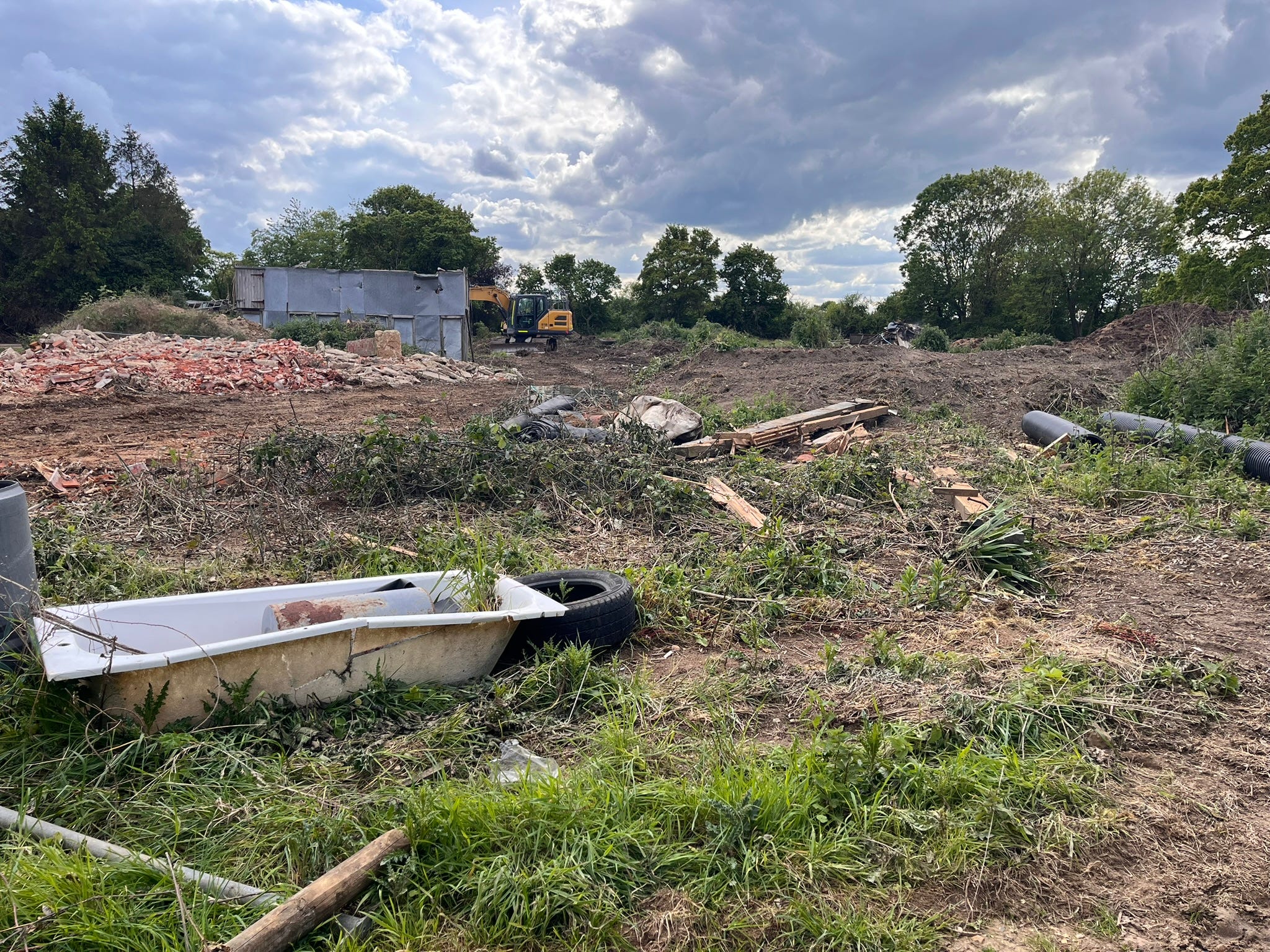
We are curious about what has been going on where the footpath runs past what I like to refer as the ugly rear end of the village. Large plumes of black and slightly acrid smelling smoke have been coming from this spot all week. Here there has long been a rickety looking old tractor shed, made from telegraph poles, corrugated sheeting, and hope, which has become a dumping ground for rubble and building materials from the estate’s various projects. Next to this is a huge pile of steaming pig crap, destined to fertilise the fields later in year, but which currently grows by the trailer-load. The whole area looks like one of those 1970s public information films designed to terrify kids into never to setting foot on a farm. We walk up the footpath to find that the tractor shed has been pulled down and that the tangles of brash left here from hedge cutting have been burnt, along with, presumably, the telegraph poles and anything else flammable. A pile of rubble remains, along with a wall made up from random metal sheets and doors. A plastic bath with a split in its side lies in the open next to a car tyre and some piping. Without the rickety tractor shed, the whole place now looks like a demolition site, which I suppose it is, and Ceci and I begin to speculate wildly about whether they intend to sell the plot for housing. Two other nearby barns have been without their roofs for some time, but look likely to be restored, as they are currently shored up with scaffolding.
Carbon Reckoning: Holding the Government to Its Own Climate Law - Crowdjustice Appeal
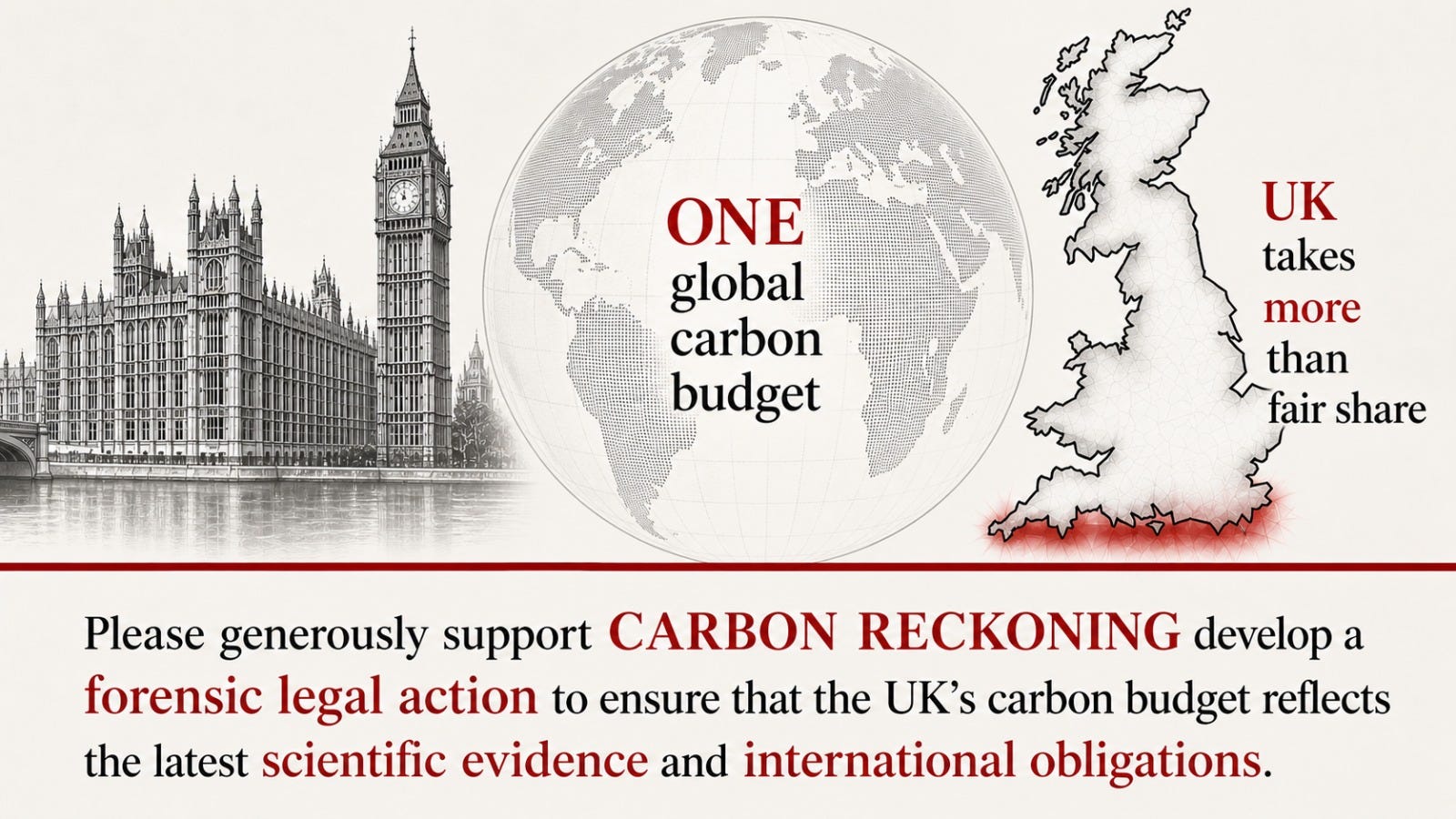
Carbon Reckoning is part of a growing movement demanding legal and parliamentary review of the UK climate plans against the latest science.
This proposed Carbon Reckoning legal action brings the latest authority on international law and climate science to bear on the inadequacy of the overall level set for the UK Seventh Carbon Budget due June 2026.
Why does this matter to you?
Getting the carbon budget right would transform all of our lives because a strong carbon budget drives:
🏠 Warmer homes and lower bills — mass investment in insulation, heat pumps and solar, reversing the £28 billion green investment pledge that Starmer abandoned before being elected
💼 Green jobs in every constituency — the long-term policy certainty UK businesses need to invest and grow in clean industries, like offshore wind
🚌 Real investment in public transport — breaking the cycle of rising transport emissions that weak carbon budgets budgets have allowed for decades
🌿 Protection for nature and food security — climate and nature are inseparable; nature, agriculture and our food security are under growing pressure
Please support Carbon Reckoning now.
You can read more about their campaign and, if you are able to, make a donation, HERE.
About ‘This Party’s Over’
On ‘This Party’s Over’ I publish my creative non-fiction, personal essays, place writing, and a country diary. My ‘Another Country Diary’ pieces are my most regular posts (about three or four a month).
The country diary can express a sort of local distinctiveness, explore a personal set of interactions with a landscape, and in doing so, almost accidentally, tease out the way the natural world is entwined with culture and politics. It can be a quietly radical and uncanny form, or sometimes just plain parochial, oddball in its specificity.
If you enjoyed this post, then follow the link below to the last one to read more, and, if you are feeling in the mood to, like, share, and subscribe for free.
Upgrade to paid for full access to the archive and to the ‘Root and Branch Nature Writing’ series.
Another wonderful piece of explorative discovery! I especially loved the ‘hedge portal’ which reminds one of the potential of nature to transport us - sometimes uncannily - beyond the limits of our conditioned expectations and self-imposed boundaries 🤗.
I miss your seminars Iain!
(e)M C