Another Country Diary #54
With snow, broken headlights, and omnicrisis.
14/02
I’m still struggling to find time to write. The workaday world has had its grip on me as I try to clear my marking and keep on top of time-consuming administrative tasks. It has been raining all week. It’s mostly finding the time and the energy when that time and energy is being diverted elsewhere that keeps me from writing, but that’s not all. The state of the world, the sense of omnicrisis, of a perpetual state of chaos and rupture, can sometimes strip me of words and motivation, leave me a numb scrolling witness to ongoing trauma and stupidity. Despite this, I believe that reading and writing can be an antidote to that kind of chaos which is being so deliberately projected by its exponents to strip people of a sense of clarity and agency. Literature is a way of bringing order to chaos; stories are a way of making sense of the seemingly senseless. Observing the world around you, bearing witness to its beauty and its horrors—in words, paint, music, performance—is perhaps the most important thing we can do right now.
In the afternoon, Ceci and I step out in the rare sunshine for a walk up to the top. I carry my hat and gloves most of the way. It is colder today, but still relatively mild for February. Where we turn off the lane for the track to the top, we watch three red kites moving from tree to tree, gliding low over the field, then with a vast wingbeat or two up to their perches. They are trying to keep away from us. One calls in a high-pitched, two-note whistling ululation to the others. It isn’t a sound I’ve heard them make before and at first I thought it was somebody whistling their dog. It is an extraordinary sound.
Later, at dusk, I set off to collect my daughter from her friend’s house and find, halfway to the next village, that I can’t see any light coming from my headlights. I think for a moment that the automatic sensor is playing up, and fiddle about with the control stalk to turn them to manual. Still no lights. I pull up and cycle through the settings. Only the daytime running lights are working, sending a cool LED glow out in front of me, but not much brighter than a good torch. The residual daylight is fading quickly and it will soon be pitch black on the country lanes. I nurse the car home again with the running lights on.
15/02
I set out early for Halfords to get the headlight bulbs changed on the car. I’m reasonably mechanically able, and don’t usually mind these sorts of jobs, but today it is sleeting and the air is numbing, and so I pay extra to have them fitted for me. I pick up my daughter on the way home. She has enjoyed her unplanned sleepover.
It begins to snow before lunch with fat wet flakes that melt as soon as they hit the ground. It is like this for about an hour, and then it begins to settle, covering the garden and the cottage in a thin layer of white. By evening it is melting, the gutters dripping where they leak.
16/02
It is half term. I use the time I’d usually be commuting to walk to “barking” woods and back. It is a short walk, but long enough to cleanse the senses and calm my thoughts.
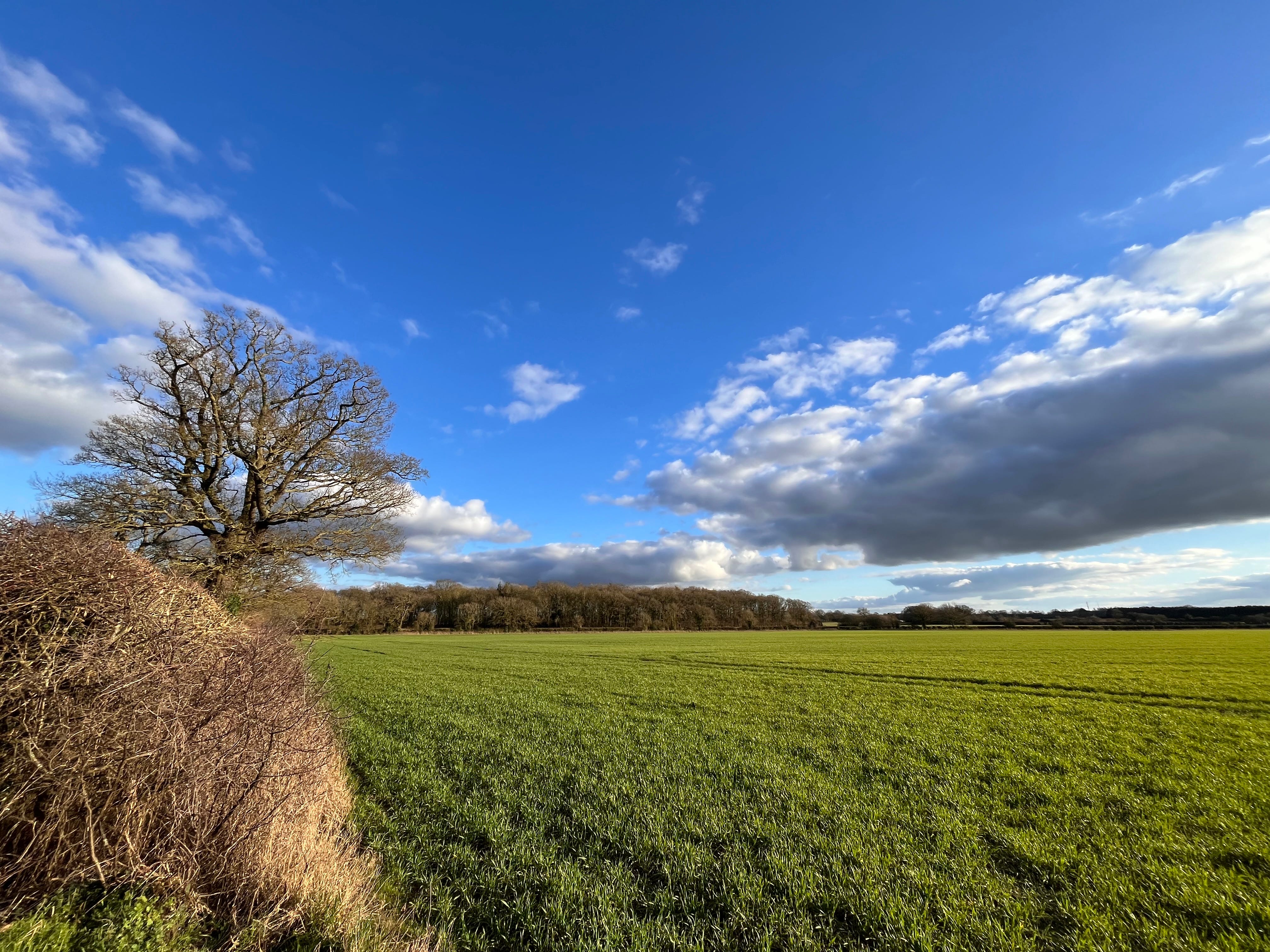
The footpath and the road leading to it are covering in long puddles. Last week’s rain and yesterday’s snow conspire to dissolve even more of the verges. The bridleway, as it passes the old orchard, is banked with snowdrops. They seem to be past their peak now. They grow plentifully in the parish, wherever there is old woodland or orchard, and in the shade of some of the old hedgerows. The path is slippery enough for me to lose balance for a moment, my boot sliding. It leads out along the edge of a wide field planted with rape. There is a steady wind from the south, cold, but the sun is bright this morning, and losing its winter weakness. I can feel its warmth on the black of my hat.
Over the field a skylark is singing. Cumulus clouds are growing in the distance. Showers are forecast. The deep ditch alongside the hedge is running with clear water drained from the fields. It will run, along a network of field ditches, until they become a tributary of a tributary of the River Yare. For much of the year the ditch is dry, but now a stream springs forth.
In the wood I’m greeted by the two-note refrain of the great tit, squeaking at me like a gate playing back and forth on a rusty hinge. There are blue tits and coal tits flitting in the canopy. A robin sings. The alarm call of a blackbird. A wren or a dunnock? I stand and listen, eyes closed, and when I open them I see a horned figure watching me from the other side of the wood. Herne the hunter. It moves, showing four legs. A roe deer. Head turned towards me, nose angled up. Another movement, and I see two more. I watch them watching me, expecting them to bolt at any moment, but they seem comfortable where they are, in the corner of a field with woods on either side of them. Perhaps it is the sunlight on them, but they seem to have lost their dark winter coats already.
Later, after work, Ceci and I take the same walk as the sun falls below the horizon. The showers haven’t amounted to much, but the cloud anvils are on either side of us, lit pink and orange by the sunset. The wind is sharper, now, the sky clearing for an icy night.
17/02
I dream that I am asked to teach my module on digital technologies and writing after a global technological collapse rendered all such technology obsolete. It is the kind of dream that lingers into wakefulness. I have been marking this module, which accounts for the dream. I taught it in the place of my beloved module on apocalyptic and post-apocalyptic writing, which might account for the civilisational collapse aspect, but something else niggles. I think perhaps in my fantasy league Higher Education I’d love to teach on a truly future-facing environmental humanities degree course that combines creative practice (writing and the arts) with modules from the sciences and social sciences (sustainability, conservation, ecology, eco-philosophy), as well as practical skills such as coppicing and tree-stewardship. There would be modules on speculative writing and nature writing. It would be a degree that prepares and equips students for a more crisis-hit future.
When we speak of future-facing, the default for many people is to think of science, digital technologies, AI. But what if facing the future means facing a world ravaged by climate and ecological collapse, food shortages, resource wars, population displacements, and technological decline? Or what if some of the skills we need to avoid such a future lie in exactly the sort of course I outline above?
20/02
There are deer in the garden. Two muntjac. They come to graze on the fresh shoots of the tulips. I go outside to shoo them, and they move in different directions, one to the copse, the other to the front of the house and into a neighbour’s garden. I go inside feeling guilty.
The morning is sunny, a little warmer. I think about going for a walk after breakfast but I’m coming down with a cold, and besides I have a lecture on Cyberpunk to revise, and the thought of it is weighing on me.
About ‘This Party’s Over’
On ‘This Party’s Over’ I publish my creative non-fiction, personal essays, place writing, and a country diary. My ‘Another Country Diary’ pieces are my most regular posts (about three or four a month).
The country diary can express a sort of local distinctiveness, explore a personal set of interactions with a landscape, and in doing so, almost accidentally, tease out the way the natural world is entwined with culture and politics. It can be a quietly radical and uncanny form, or sometimes just plain parochial, oddball in its specificity.
If you enjoyed this post, then follow the link below to the last one to read more, and, if you are feeling in the mood to, like, share, and subscribe for free.
Upgrade to paid for full access to the archive and to the ‘Root and Branch Nature Writing’ series.


Do you know about the Edinburgh Futures Institute, part of the University of Edinburgh. They offer an undergraduate degree and a range of postgrad degrees, all aimed at facing the challenges of the future (tho I don't think coppicing and tree-stewardship are included, sadly:
https://efi.ed.ac.uk/study/undergraduate/
https://efi.ed.ac.uk/study/postgraduate/
Lovely photos and reflections. I know what you mean about the struggle to find time. Hang in there; I think your efforts are worth it.