
Another Country Diary #51
With snow, bones, and dark arrows.


28/12
I wake from the deepest, longest sleep that I can recall. Eight and a half hours might not sound like much, but it feels like a miracle after a year of insomnia. It leaves me feeling groggy all morning, so much so that I suspect I might be coming down with something. Perhaps though, my body is telling me to slow down and recuperate.
The day is overcast and I spend much of it reading or doing scraps of writing. We have a lunch of cold cuts fairly late in the day and afterwards, Ceci and I set out for a quick walk under the dull grey skies, walking to ‘barking woods’, and back. It is past three, and with a day as drab and low-lit as this, most of the birds seem to already be roosting. I spot a few tits and blackbirds making darting flights between hedges. The hazels already have catkins forming. In six weeks or so they will be ready to release pollen. Even in the depths of winter there is growth and change, a slow stirring towards the light of summer. On the way back Ceci spots a tree covered in red baubles, which, as we walk closer, resolve into crab apples. It is a little off the path, but even so, it is surprising that we haven’t noticed it before. Most of the apples are still in the tree, though there is a scattering on the ground. It must be a very late fruiting variety. The tree is tall, and looks to be a veteran. It sits on an old hedgerow that marked the edge of a series of small fields that belonged to a farm long subsumed into the estate. Old OS maps show many orchards, but I wonder if this tree is a throwback to those times.
30/12
We get up to bright skies and still air. There has been a light frost, though it burns off quickly. There is no sign of the lapwings in the big field next to the lanes, just a scattering of common gulls strutting in or soaring over the crops. Two red kites are roosting at the top of the bare branches of an ash. A third flies to join them. They have a good vantage of the fields on either side and fly off only as we walk beneath them. We catch sight of them again over one of the fields left fallow, and later on in our walk, another, one of the three or another bird entirely, is soaring over the track.
As we walk down next to the hedgerow that leads to the lower fields there is a growing cacophony of voices. Linnets, all singing at once their overlapping chattering calls. There is an exuberant energy to them, like schoolchildren in a playground. As we approach their tree they peel off in small groups to gather at a safer distance, and then reverse the process as we reach their new perch. Linnets are finches and they feed on the seedheads left in the fields. A number of fields have been planted with various seeding plants for regenerative farming and temporary habitat creation, and for the last couple of winters the linnets have gathered here in large numbers. They are pretty, understated birds; russet coloured and fast in their movements.
We follow the footpaths to the church in the next parish, cutting across a wide field. The open space is in fact three separate fields, but the only indications of the transition that can be seen are slight banks and ditches. It would have been divided into more parcels, and I’m fairly certain that the path that cuts across the field follows an old boundary between the fields.
31/12
The last day of a long year. It is bright and very cold. Cold enough for the glass skylights in our kitchen to freeze over with intricate fractals. The firewood is getting low. I place an order, but I suspect that we will run out before it arrives. In the coldest weather our central heating is rarely enough to keep the cottage warm.
We find the mob of fieldfares that we’d noted in the hedges by the lanes, up at the hollow next to the track that runs to ‘the top’. The hollow is probably an old gravel or flint quarry. It is marked as a pond on maps, but I’ve never seen water in it. The bottom of it is thick with elder and brambles, and the banks dense with nettles. It is ringed by hawthorn and young ash trees. The fieldfares are here for the hawthorn, stripping the trees one by one of the bright red berries. A couple of buzzards circle hear by, calling back and forth. A cock pheasant and two hens come rattling and clucking out of the thicket around the hollow into a short low flight to the far end of the field.
1/1/2026
The cold remains, but the sun is lost, a bright spot behind watery clouds. The wind is strong as we walk off our hangovers, the windchill drawing the heat off every exposed bit of skin. The hedge on the way to ‘barking woods’ is still full of haws and rosehips in various shades of red, but I don’t notice any birds. The wind falls as we enter the woods. I thought it was the shelter of the trees, but as we walk back it is clear that the wind has died, whatever invisible patch of turbulence that had caused it having passed. The village pond is covered in thin ice. The water is lower than it should be at this time of year.
At sunset the sky glows with vibrant hues of violet and magenta, colours that seem almost unreal.
3/1
The cold deepens. We wake to light snow swirling outside our widows. A kite valiantly quarters the field next door. I attend to the usual fireside chores. The clearing of ash. The loading of firewood into the wheelbarrow. Stacking wood by the fireplaces. Using the hatchet to cut a supply of kindling. We are running low on wood, and I suspect we will run out before the next delivery next week.
We also wake to fire of a more distant kind. A news alert on my phone. US bombs falling on Venezuela. The world becoming more dangerous by increments. Wolves circling.
The snow squalls and swirls all day in light showers. We are on the edges, nothing consequential settles. I feel relieved as snow makes everything harder, but the child in me longs for its transformational magic.
Later, our firewood supplier emails to say that he’ll deliver to us tomorrow.
4/1
I spend the morning moving logs. The existing stockpile all goes indoors, two wheelbarrows worth, and then once the tipper truck arrives with the fresh firewood, we begin the slow process of filling the wheelbarrow and stacking it in the log-store outside. Even with the two of us working on in, the whole process must have taken about two hours—work made harder by the cold. Afterwards, I empty yesterdays ashes and relight the stove. It is 14 degrees in the cottage, but by lunchtime the temperature has crept up to a balmy 17.


In the afternoon we walk up to the hollow by the track under an empty frozen sky. The puddles in the field entrances are frozen over with thick ice, and covered with a dusting of snow. It shows the tracks of a bird, a woodpigeon perhaps. The hedges in the lanes look stripped back, green only where there is ivy or gorse. A few ravens strut and flap about the large field.
At the hollow we decide to explore, walking its perimeter on the edge of a field that is being rested. The sides of the hollow form an almost sheer drop, and it is clear that it was once an area of excavation, possibly for gravel or flint. Hawthorn, elder, and hazel grow along the sides of the hollow. They are mature trees, with one hawthorn in particularly showing a few veteran features. The hazels look to have been coppiced in the past. The earth banks, and the area sheltered by the canopy of the old hawthorn, are pocked with entrances to burrows, some large enough for rabbits, others perhaps belonging to rats. There are occasional diggings, scrapes in the ground, that I suspect might have been made by badgers. If there is a sett, then the entrance is well hidden.
As we reach the far side of the hollow, Ceci spots a bone. It looks like a humerus from a mammal. Then we notice more bones scattered, a skull, and then another. The skulls are not complete, but it is clear from the antlers that one belonged to a roe deer and the other to a muntjac deer. It is a secluded spot, under the shade of trees, next to a wooded hollow, far from roads and out of direct sight from the track. It was probably a good place for an exhausted and ailing animal to rest and die. The bones have been scattered all around by scavengers—foxes and kites perhaps. Part of a jaw. Ribs. Vertebrae. I wonder how long they have been here. The scavengers would make quick work of a corpse, I’m sure.


5/1
It snows overnight.
The sun is just beginning to shine through the trees in the copse as I take the ashes from the stoves out. It is a clear golden light. The world feels hushed, muffled by the soft accumulation.
A Red Kite moves slowly over the field next door, then overhead and away.
It isn’t long before our cat, Benji, comes to the door with something in his mouth. Usually he is secretive with his kills, taking them under the bush, but I’m guessing it is too cold and he wants the best of both worlds. It is a robin.
I try not to get angry with him when he does this. We are glad enough when he catches rats. But a robin on a snowy day like this is almost too much, as if he has transgressed some law of Christmas card scenes. I open the door to shoo him. He opens his mouth. The robin flies into our kitchen.
The robin can fly, but it cannot stand. When it lands it slumps awkwardly. Ceci gets a shoebox and some straw while Benji stalks us through the glass doors. The robin is placed out of harms way and we hope for the best. Later, it is recovered enough to be standing, and Ceci moves it to the hen’s area, which is cat free, to recover further. There is more to this story, but it’s too upsetting for much detail. Let’s just say that the small birds fared badly on this snowy morning, and that we confined Benji to the house for the remainder of the day, where he stretched out in front of the fire like a tabby rug.
The sky is still mostly clear when we set out for a walk, but there is a cloud building to the west, growing larger. My daughters stop for Instagramable photos on the lanes, which have been barely touched by tires or boots this morning. The air is so cold it stings exposed skin. The world feels newly born, transfigured.
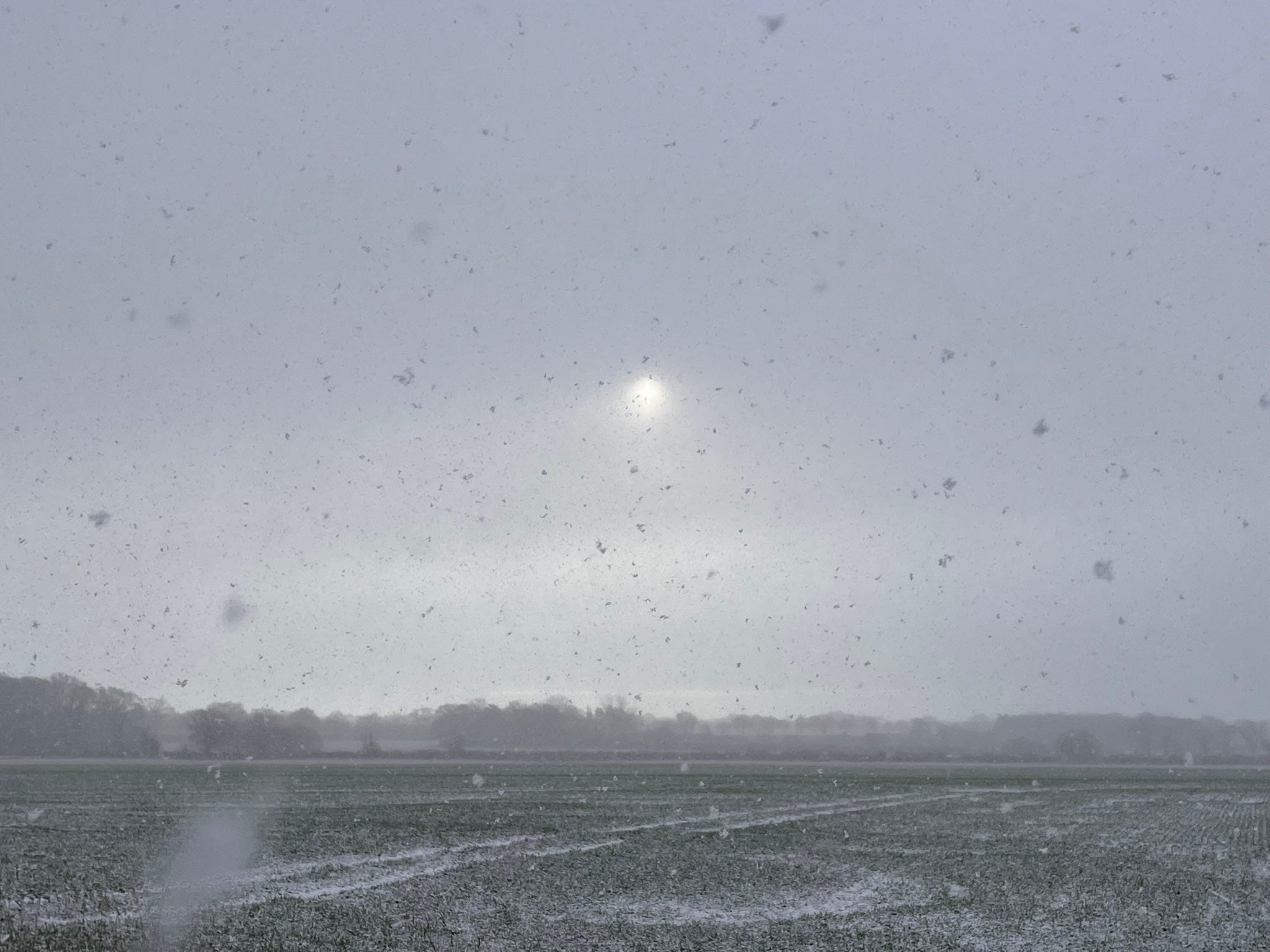
At the top of the lane the snow shower reaches us and the blue sky turns grey, the air dense with large swirling flakes. The sun dims and becomes an alien star viewed from an icy planet. We pull scarves closer and push on up the track to the top. The ice is thick where puddles have cracked. There are the tracks of deer. Frozen horse dung. By the time we turn back our boot prints are already being covered over.
When the moon rises in the evening the snowscape glows with its cold light.
6/1
Reyes! or epiphany. By tradition our daughters have presents in their boots, though neither of them remembered to leave their boots out this year. There is a back to school feeling about the day. I am on annual leave, but I find myself tinkering with work emails, catching up on the mountain of emails I flagged for follow-up before Christmas. I woke early, anxious about the weeks ahead.
I spend most of the day by the fire. I move logs. Empty ashes. All the usual chores.
We begin to pack up the festivities. It is a slow letting go. A few decorations at a time. The Christmas placemats, mugs, and glasses are packed away for another year.

13/1
For a week I’ve found myself unable to write.
There is so much going on in the world that disturbs and distracts my thoughts. So much brutality, hatred, and injustice. It is alarming to witness. It is designed, for the most part, to make ordinary people live in fear and allow powerful people to abuse the system and their power unchallenged. Bullying makes me furious, brings out the traumatised victim in me, the boy bullied by his teacher.
Going out into nature, into the real world, and responding to its truth feels inadequate. I’ve felt similarly before, and stopped writing for a long period after certain major political events unsettled me. But going out into nature and responding to its truth also feels like the most vital, important thing to do, especially at this time when the natural world seems so embattled, so threatened by those who would seek to rid it of protections at precisely the moment it needs them the most.
Ceci and I set out after lunch, walking along the field edges to the woods and back, following the straight path of the bridleway alongside fields of rapeseed. The last couple of days and nights have been milder, but today threatens rain, and the sky is clouded with a high light-grey stratus and a ragged layer of darker cumulus below them. The cumulus is thinning, blowing in fast rags, and all the way along the path the clouds thunder with American fighter jets, one after the other, falling towards their base at Lakenheath.
Four roe deer leap across the path about a hundred metres in front of us. We probably spooked them with our chatter. The jets thunder and the four bobbing white tails move across the field before settling into the treeline of the woods. The ditches are looking wetter following the snow and the wetter weather. In the woods, the air is brackish. These woods are always damp, growing as they are on old clay pits from brickmaking. Last year’s undergrowth is a brownish tangle of bramble and nettle stalks and sticky-weed growing over the rotting trunks of fallen trees.
We turn back to avoid the road. the clouds are lifting slightly, the cumulus thinning, and the roars of the jets turn into their sharp black silhouettes. Dark arrows. Dark omens. Like the deer they seem to come in flights of four, one every minute or so, a gap, perhaps a straggler, then another four. Dozens in the time we have been walking. Are they the usual wargamers? We can’t remember so many leaving this morning but maybe they took a different route. And still they come. We watch one come over a little too low. The pilot guns the throttle to gain altitude and drowns out the song of a robin and the calls of tits as we enter the edge of an old orchard.
The jets are off again at night, slicing the darkness with their sharp roar. Going out into nature and responding to its truth feels like the only thing I can do in this troubled, broken age.
Many thanks to those of you who have upgraded your subscriptions to support my writing on here or who recommend this page. Please consider a paid subscription to help me keep these posts a viable pursuit.
About ‘This Party’s Over’
On ‘This Party’s Over’ I publish my creative non-fiction, personal essays, place writing, and a country diary. My ‘Another Country Diary’ pieces are my most regular posts (about three or four a month).
The country diary can express a sort of local distinctiveness, explore a personal set of interactions with a landscape, and in doing so, almost accidentally, tease out the way the natural world is entwined with culture and politics. It can be a quietly radical and uncanny form, or sometimes just plain parochial, oddball in its specificity.
If you enjoyed this post, then follow the link below to the last one to read more, and, if you are feeling in the mood to, like, share, and subscribe for free.
Upgrade to paid for full access to the archive and to the ‘Root and Branch Nature Writing’ series.
“Going out into nature and responding to its truth feels like the only thing I can do in this troubled, broken age.”
I’m reading this six weeks later (too many newsletters in my inbox) and still feel this way. The BS doesn’t let up, and sometimes I have to force myself to the page, but that’s where I find comfort and belonging, as well as challenge and purpose.
I’ve also gone fairly quiet in public writing. I have nothing substantive to add to the outcry, yet remaining silent feels false. So I notice the light (sunrise is visibly moving north along the horizon!!) and share that.
It may sound like despair, but it doesn’t feel like it, to take comfort in the fact that the sun and moon will rise and set after all of us are gone. (“Rise” and “set,” I suppose.)